What is Decentralized Finance? A Simple Guide to DeFi

Think about your bank. It's like a private club with bouncers at the door, deciding who gets in and what they're allowed to do once inside. Now, imagine a public park—it's open to everyone, the rules are clear for all to see, and there’s no single person in charge. That's the essence of Decentralized Finance, or DeFi.
It’s a ground-up rethinking of the financial system, built on blockchain technology, that cuts out the traditional middlemen like banks and brokerage firms.
Unlocking a New Financial System
Instead of relying on a human or a corporation to approve a loan or process a trade, DeFi uses something called smart contracts. These are basically just pieces of code that automatically execute agreements—lending, borrowing, trading, you name it—once certain conditions are met. This setup puts you, the user, in the driver's seat.
The whole point is to create a financial world that's more open, runs more smoothly, and is far more transparent than what we have today. It's a shift from closed-off, centralized institutions to an open-source model where anyone can participate, build new tools, or just look under the hood to see how things work. You don't need anyone's permission to join in.
The Core Pillars of DeFi
The entire DeFi ecosystem is built on a handful of key ideas that really set it apart from the old way of doing things. These pillars are what make the system work without a central boss.
- No Intermediaries: DeFi connects people directly, getting rid of the need for banks or brokers to facilitate transactions.
- Complete Transparency: Every single transaction is recorded on a public blockchain. This creates a permanent, tamper-proof record that anyone can check at any time.
- User Sovereignty: You are in control of your own money. Using self-custody wallets, only you hold the "private keys" that grant access to your funds.
- Open Access: If you have an internet connection and a crypto wallet, you can access DeFi services. It doesn’t matter where you live or how much money you have.
This infographic breaks down how these concepts come together to form the foundation of DeFi.
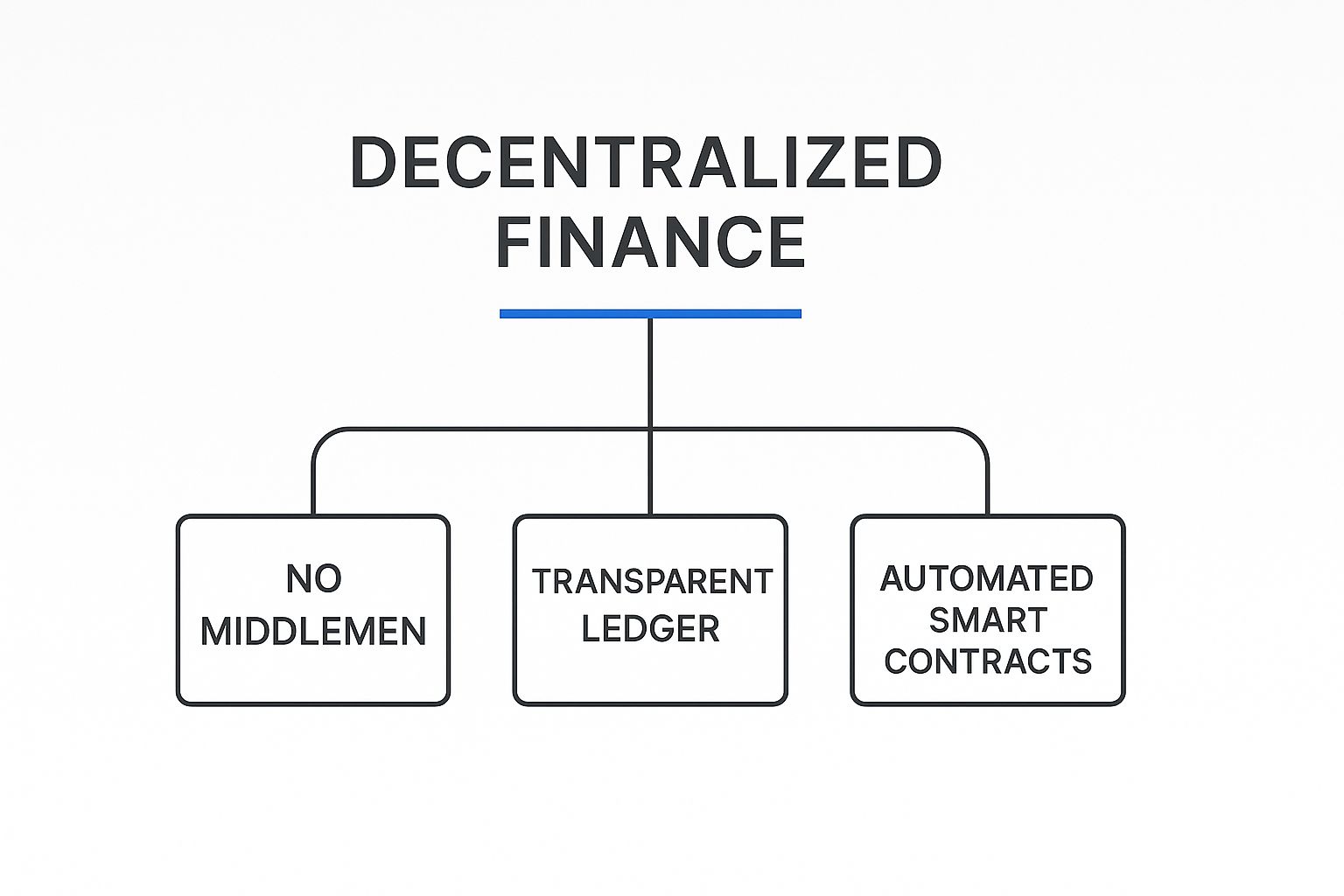
As you can see, DeFi's real strength lies in how it combines automated code, total transparency, and the absence of a central authority.
A Visual Glimpse into the DeFi World
Websites like Ethereum.org offer great explanations and visuals that show what this ecosystem looks like in the real world. They do a fantastic job of comparing familiar financial services to their new DeFi equivalents, which helps make the whole concept click.
The following screenshot from their site illustrates how everyday financial activities are being completely reimagined.
At its heart, DeFi isn't really inventing brand-new financial concepts. Instead, it’s rebuilding the plumbing behind them—the infrastructure that powers finance—to be more open, fair, and efficient for everyone involved. That fundamental shift is what makes it so important.
The Building Blocks of DeFi Technology
So, how does this new financial system actually work without banks pulling the strings? It all boils down to a few key technologies working in concert. Think of them as the essential parts of an engine—each with a specific job, but all needed to power the entire DeFi machine.
Getting a handle on these core elements is the key to understanding what decentralized finance is all about. It shows you how DeFi can not only mimic traditional financial services but, in many cases, improve upon them.

Smart Contracts: The Automated Rule-Keepers
At the very heart of DeFi, you'll find smart contracts. The best way to think of them isn't as legal documents but as super-powered digital vending machines. You put in your crypto, select what you want to do (like lend or trade), and the machine automatically executes the transaction based on its programming. No cashier needed.
These are self-executing contracts written in code and stored on a blockchain. They automatically enforce the terms of an agreement, meaning if certain conditions are met, the contract runs itself without anyone's approval. This is what makes DeFi so efficient—it cuts out the middlemen.
Blockchain: The Unshakeable Foundation
All of this activity needs to be recorded somewhere safe and open for everyone to see. That place is the blockchain. A blockchain is basically a shared digital notebook that’s copied and spread across a massive network of computers.
Once a transaction is added to this notebook, it's nearly impossible to alter or cheat. This creates a secure, verifiable record of everything that happens. While several blockchains can run DeFi applications, the Ethereum blockchain has long been the dominant playground because of its powerful smart contract features.
The blockchain provides the trust. Since every transaction is public and permanent, anyone can verify it for themselves. This builds a system where trust is baked into the code, not placed in a fallible institution.
Decentralized Apps (dApps): The User-Friendly Interface
Thankfully, you don't need to be a coder to use smart contracts. That's where decentralized applications (dApps) come into play. These are the familiar websites and mobile apps that connect you to the underlying DeFi protocols.
If the smart contract is the vending machine's inner workings, the dApp is the front panel with the buttons you press to make a choice. They make DeFi accessible, allowing you to lend, borrow, and trade with just a few clicks.
Stablecoins: The Price Stabilizers
One of the biggest knocks on crypto for everyday finance is its wild price swings. Stablecoins are the answer to this problem. They are a special kind of cryptocurrency designed to hold a steady value because they are pegged to a stable asset, usually a real-world currency like the U.S. dollar.
This stability makes them perfect for DeFi. They provide a reliable way to transact and a stable store of value, so you can lend or borrow without worrying that your assets will be worth half as much tomorrow. Their importance is clear from their adoption—as of June 2025, there was $146 billion in stablecoins circulating in DeFi. This is part of a much bigger picture; some analysts predict the future of decentralized finance could see the global market hit $231.19 billion by 2030.
Traditional Finance vs. Decentralized Finance
To really grasp the shift that DeFi represents, it helps to see it side-by-side with the system we all know. The table below breaks down the key differences between the old world and the new.
| Feature | Traditional Finance (TradFi) | Decentralized Finance (DeFi) |
|---|---|---|
| Intermediaries | Relies on banks, brokers, and institutions. | Removes intermediaries; users interact directly. |
| Accessibility | Requires ID, bank account; can be exclusive. | Open to anyone with an internet connection. |
| Transparency | Operations are often private and opaque. | All transactions are public on the blockchain. |
| Control | Your assets are held by a third party. | You have full self-custody of your assets. |
| Operating Hours | Follows standard business hours and holidays. | Always on, 24/7/365. |
| Speed | Transactions can take days to settle. | Transactions settle in minutes or seconds. |
As you can see, the core philosophy is fundamentally different. DeFi is about building a financial system that is more open, efficient, and user-controlled from the ground up.
How People Use DeFi in the Real World
The tech behind decentralized finance is fascinating, but its true power shines when you see what people are actually doing with it. This isn't just some abstract theory—DeFi is a vibrant, bustling ecosystem where billions of dollars in financial activity happens every single day. These applications are essentially rebuilding the traditional financial world, from trading to lending, but on an open and permissionless foundation.
So, let's dive into some of the most practical ways people are using DeFi right now. These examples show how heady ideas like smart contracts and blockchains become tangible, everyday financial tools.

Trading on Decentralized Exchanges (DEXs)
One of the most popular things to do in DeFi is trading digital assets on Decentralized Exchanges (DEXs). You can think of a DEX as a peer-to-peer marketplace for crypto. Instead of a central company like Coinbase holding your money and matching trades, a DEX uses smart contracts to let you swap tokens directly from your own wallet.
This peer-to-peer approach comes with some huge advantages:
- Full Custody: Your assets never leave your control until the moment a trade happens. You are always in charge.
- Permissionless Access: Anyone with a crypto wallet can trade. There are no sign-ups, identity checks, or approvals needed.
- Vast Token Selection: DEXs are often the first place to find new and niche tokens, long before they ever hit the major centralized exchanges.
Uniswap is a perfect example. As a leading DEX on Ethereum, it pioneered the "automated market maker" (AMM) model. Users supply their crypto to "liquidity pools," and a smart contract handles all the trading against that pool. This creates a market that’s always on, available to anyone, anywhere.
Earning Interest Through Lending and Borrowing
Another major pillar of DeFi is decentralized lending and borrowing. Protocols like Aave and Compound work like automated money markets. They let you deposit your crypto and earn interest, similar to a high-yield savings account but often with much better rates.
On the other side of the coin, you can also use these platforms to take out a loan. Forget credit checks and mountains of paperwork. Here, you simply provide other crypto assets as collateral to borrow against.
The entire process is run by code. A smart contract sets interest rates based on real-time supply and demand, and it makes sure every loan is over-collateralized to protect lenders. This creates a far more efficient and accessible system for both savers and borrowers.
This model blows the doors wide open for global finance. Someone in Southeast Asia can seamlessly lend assets to someone in North America without a single bank acting as an intermediary.
Maximizing Returns with Yield Farming
For those with a higher appetite for risk, yield farming has become a defining DeFi activity. Simply put, yield farming is the art of strategically moving your crypto assets between different protocols to hunt down the highest possible rewards, or "yield."
It’s like chasing the best interest rates between different banks, but supercharged. A typical yield farmer might:
- Provide liquidity to a DEX like Uniswap to earn a share of the trading fees.
- Stake the receipt tokens from the DEX into another lending protocol to earn even more rewards.
- Constantly monitor the ecosystem for new, more profitable opportunities.
While the returns can be impressive, yield farming is complex and not for the faint of heart. It demands a deep understanding of how different protocols work together and comes with serious risks like smart contract bugs and wild market swings.
Exploring Advanced DeFi Applications
Beyond the core functions of trading and lending, the DeFi ecosystem is a hotbed of innovation. Think of these different protocols as "money legos" that can be snapped together in new ways to create financial products that were never possible before.
Some of the other exciting areas gaining traction include:
- Decentralized Insurance: Platforms like Nexus Mutual allow users to pool their money to create community-owned insurance, offering protection against things like smart contract failures.
- Prediction Markets: Protocols such as Augur let people bet on the outcome of real-world events, whether it's an election result or the winner of a major sports tournament.
- Asset Management: Tools like Yearn Finance act as robotic financial advisors, automatically shifting users' funds between different lending protocols to always secure the best yields.
The pace of innovation is relentless. Looking forward, concepts like Self-Sovereign Identity (SSI) and Decentralized Identifiers (DIDs) are poised to change the game by solving how we establish trust and manage our identities online. This could make DeFi even more secure and user-friendly in the years to come.
What's Driving the DeFi Boom?
The explosion in decentralized finance isn't just hype. It's a direct answer to some very real frustrations people have with the old way of doing banking. At its heart, DeFi is gaining traction because it offers a fundamentally different and, for many, a better way to manage money.
And the numbers back this up. The total value locked (TVL) in DeFi protocols—a great way to measure the sector's health—is expected to hit $123.6 billion by 2025. That’s a staggering 41% year-over-year jump. Right now, North America is leading the pack, making up 36.32% of the global revenue, but keep an eye on the Asia Pacific region—it’s catching up fast thanks to a wave of new financial startups. You can dig deeper into these DeFi market statistics on CoinLaw.io.
So, what's pulling people in? It comes down to a few core ideas.
Finance That's Actually Open to Everyone
Let's be honest: traditional finance is full of gatekeepers. Want a loan? You need a good credit score. Want to open an account? You need the right paperwork and have to live in the right place. DeFi tears down these walls.
All you need is an internet connection and a crypto wallet. Suddenly, a global financial marketplace is at your fingertips, no matter who you are, where you live, or how much money you start with. It’s a genuine level playing field, bringing tools once reserved for the wealthy to anyone who wants them.
Transparency You Can See and Trust
In the old system, a lot happens behind closed doors. You're asked to simply trust that your bank is doing the right thing with your money, but you can never really look under the hood. DeFi is built differently—it's transparent by design.
Every transaction is logged on a public blockchain, creating a permanent, tamper-proof record that anyone can check. It’s not about exposing your identity, but about making the flow of money completely visible.
This is where the idea of verifiable trust comes in. Instead of trusting a person or a company, you trust the code. The rules are laid out in smart contracts that are open for anyone to read, so you can be confident the system will work exactly as it says it will.
You Are in Complete Control of Your Money
When you put your money in a bank, you're essentially giving them a loan. They hold it for you, but they can also freeze your account or tell you how much you can withdraw. With DeFi, that power dynamic is flipped. You have total sovereignty.
By using a self-custody wallet, you—and only you—hold the private keys to your funds. This is a simple concept with massive implications:
- Your assets are truly yours. No one can move them without your keys.
- You call the shots. You can send, trade, or lend your funds whenever you want, 24/7, without asking for permission.
- You become your own bank. This brings back a level of personal control over one's wealth that has been missing for a long time.
A Faster, More Creative Financial World
Finally, DeFi is just more efficient. The traditional financial system is notoriously slow and clunky, tangled up in manual processes and intermediaries. An international transfer can take days. DeFi transactions, powered by automated smart contracts, settle in minutes and often for a fraction of the cost.
But the real magic is something called composability, which many people call "money LEGOs." Since DeFi protocols are open-source, developers can snap them together in new and interesting ways, building on top of each other's work to create entirely new products. This collaborative spirit fuels an incredible pace of innovation that legacy finance just can't keep up with.
Navigating the Real Risks in DeFi
DeFi is an exciting frontier, but it’s crucial to walk in with your eyes wide open. This isn't some risk-free financial paradise; it's a highly experimental space where real money can be lost. Getting a handle on these challenges is the first step to engaging with DeFi safely and smartly.
The lure of high yields can easily distract from the very real hurdles this industry is still trying to clear. We've seen everything from massive security breaches and simple user errors to the looming shadow of regulatory uncertainty. These issues have caused major setbacks and shaken out users after periods of hype.
That said, the space keeps innovating. In the first half of 2025 alone, cross-chain stablecoin bridges handled over $12.6 billion in value, and the market for synthetic assets like tokenized real estate hit a $3.2 billion market cap. Numbers like these show the incredible power at play, but they also underscore the volatility. To really understand what you're getting into, it's worth digging into the data on the DeFi market's growth and challenges.
Smart Contract Vulnerabilities
In DeFi, the saying goes, "code is law." But what happens when that law has a loophole? Smart contracts are the foundation of everything, but a single bug in the code can become an open door for hackers, leading to catastrophic losses for users.
Once a smart contract is live on the blockchain, it's generally there to stay—it can't just be patched like a normal app. This immutability is a feature, not a bug, as it prevents tampering. The downside? A vulnerability discovered after launch can be a permanent, ticking time bomb.
This is exactly why code audits are non-negotiable. Reputable DeFi projects hire specialized security firms to tear their code apart looking for flaws. Before you put a single dollar into a new protocol, always check if it has passed multiple, thorough audits.
Extreme Market Volatility
If you know anything about crypto, you know it’s a rollercoaster. DeFi is no different. The value of the assets you've locked into a protocol can drop dramatically in a matter of hours, taking your portfolio down with it.
This volatility isn't just about the price of your tokens falling. It creates another, more complex risk for people who provide liquidity to decentralized exchanges—a sneaky little concept known as impermanent loss.
Understanding Impermanent Loss
Impermanent loss is one of those DeFi concepts that trips up even experienced users. It's a potential loss you can suffer when you provide assets to a liquidity pool, compared to if you had just held onto those same assets in your wallet.
- What it is: A temporary drop in the value of your deposited assets when compared to simply holding them.
- When it happens: It kicks in whenever the prices of the two tokens in the pool move apart from each other, in either direction. The bigger the price difference, the bigger the impermanent loss.
- Why it matters: The loss is "impermanent" because it only becomes real if you withdraw your funds at that point. If the token prices return to where they were when you deposited, the loss vanishes.
Think of it as the price you pay for earning trading fees from the pool. It’s a trade-off that many newcomers don't see coming.
Regulatory and User Experience Hurdles
The rules for DeFi are still being written, which creates a fog of uncertainty. Governments around the world are trying to figure out how to handle this new financial system. A sudden policy change or a regulatory crackdown could send shockwaves through the entire ecosystem, impacting the value of your holdings.
Finally, just using DeFi can be a challenge. The user experience (UX) often feels like it was built by developers, for developers. Managing private keys, navigating different wallets, paying for transaction "gas" fees, and wrapping your head around complex protocols creates a steep learning curve. In this environment, a simple mistake can be permanent and costly.
Navigating these risks requires a healthy dose of caution and a commitment to doing your own research. Below is a quick summary of the most common risks and what you can do about them.
Common DeFi Risks and Mitigation Strategies
| Risk Type | Description | How to Mitigate |
|---|---|---|
| Smart Contract Bugs | Flaws or vulnerabilities in the code of a DeFi protocol that can be exploited by attackers, leading to the theft of funds. | Only use protocols that have undergone multiple, reputable security audits. Check audit reports yourself and avoid brand-new, unaudited projects. |
| Market Volatility | The prices of cryptocurrencies can fluctuate wildly, leading to significant and rapid losses in the value of your assets. | Diversify your portfolio across different assets and protocols. Avoid using high leverage and never invest more than you can afford to lose. |
| Impermanent Loss | A potential loss of value experienced by liquidity providers when the price of tokens in a pool changes compared to simply holding them. | Provide liquidity for stablecoin pairs (e.g., USDC-DAI) or for tokens you believe in long-term. Use impermanent loss calculators to understand your potential risk. |
| Regulatory Uncertainty | Governments may introduce new laws or regulations that could negatively impact DeFi protocols, tokens, or the entire market. | Stay informed about regulatory developments in your jurisdiction. Consider geographic diversification if possible. |
| Rug Pulls & Scams | Malicious developers create a project, attract investors' funds, and then disappear with the money, leaving the token worthless. | Research the team behind the project—are they anonymous or public? Look for red flags like a locked liquidity pool and a transparent development roadmap. |
| User Error | Simple mistakes like sending funds to the wrong address, losing your private keys, or approving a malicious transaction. | Double-check every transaction and address. Use a hardware wallet for significant funds and never share your seed phrase with anyone. |
Ultimately, while the risks are very real, they are not insurmountable. A well-informed and cautious approach can help you tap into the potential of DeFi while keeping your assets as safe as possible.
How to Get Started with DeFi Safely
Jumping into decentralized finance can feel a bit like learning a new language, but with a bit of caution and a clear plan, you can navigate it like a pro. The goal isn't to get rich quick; it's to build your knowledge from the ground up so you can explore this new financial frontier with confidence.
Your first move is creating your own personal gateway into the DeFi world. This means setting up a self-custody wallet—a type of digital wallet where you, and only you, hold the keys. Think of it as your digital vault and passport all in one.

Your First Steps into DeFi
Getting your feet wet involves just a few key steps. Wallets like MetaMask or Trust Wallet are great starting points because they’re built to be user-friendly and connect easily with most DeFi applications (dApps).
-
Set Up a Self-Custody Wallet: Download a well-known wallet app and follow the setup process to the letter. Crucially, write down your seed phrase (a list of 12 or 24 words) and hide it somewhere safe and offline. This is your master key—lose it, and you lose access to your funds forever.
-
Fund Your Wallet: You’ll need to buy a small amount of cryptocurrency from an exchange and send it over to your new wallet. It’s a good idea to start with a popular crypto like Ethereum (ETH), since it's the currency used to pay for transaction fees (known as "gas") on its network.
-
Start Small, Learn Big: Here’s the number one rule of DeFi: never invest more than you are prepared to lose. Use a tiny amount of money to play around with different platforms. This lets you learn the ropes—how to lend, swap, or provide liquidity—without risking anything significant.
Keep in mind that every transaction on a blockchain is final. There are no do-overs. So, take your time, double-check every address, and think of your initial forays as a learning experience, not just a financial one.
Identifying Trustworthy Platforms
Let's be clear: not all DeFi projects are built the same. Your security really comes down to telling the good ones from the bad. Before you even get into specific platforms, it helps to have a solid grasp of crypto trading fundamentals. You can get up to speed with a comprehensive crypto trading guide that lays out all the core concepts.
When you're ready to evaluate a DeFi protocol, here are a few things to look for:
- Security Audits: Has the project been audited by reputable security firms? Legitimate projects are proud of their audit reports and make them easy to find.
- Transparent Team: Do you know who is behind the project? A public, well-known team adds a massive layer of accountability, though anonymity isn't always a deal-breaker.
- Active Community: Check out their Discord, Telegram, or Twitter. A bustling, engaged community is often a sign of a healthy project with long-term potential.
By taking these steps—starting with a secure wallet, risking only what you can afford, and doing your homework on every platform—you can begin your DeFi journey on the right foot.
Common Questions About DeFi, Answered
As you get more familiar with decentralized finance, a few common questions tend to pop up. Let's tackle some of the most frequent ones to clear up any lingering confusion.
Is DeFi the Same as Bitcoin?
Not at all. The two are related but serve very different purposes.
Think of Bitcoin as the original invention—a decentralized digital money and payment network. It's designed to do one thing incredibly well: be a secure, peer-to-peer electronic cash system.
DeFi, on the other hand, is a much broader concept. It’s an entire ecosystem of financial applications built on top of programmable blockchains like Ethereum. DeFi isn't a single coin; it's a whole universe of tools for lending, borrowing, trading, and earning interest. To use an analogy, if Bitcoin is like digital gold, DeFi is the entire global financial market—stocks, bonds, banking, and all—rebuilt on the blockchain.
Do I Need a Lot of Money to Get Started?
Definitely not. One of the best things about DeFi is how open it is. You can jump in and start experimenting with just a few dollars, which is exactly how most people should begin.
The main thing to watch out for are transaction costs, known as "gas fees." These can sometimes be surprisingly high, especially when the network is busy. A good rule of thumb is to only start with an amount you'd be perfectly fine with losing. Treat your first steps as a learning expense.
The low barrier to entry is a key feature, not a bug. It allows anyone, anywhere, to participate in a global financial system without needing significant capital, which stands in stark contrast to traditional finance.
Is DeFi Safe to Use?
This is where you need to be careful. DeFi is still in its early days, and that pioneering spirit comes with real risks. The blockchain technology itself is incredibly secure, but the smart contracts running on top of it can have flaws.
Hackers are always on the lookout for bugs or vulnerabilities in a protocol's code, and they can exploit them to drain funds. This is why it’s so important to stick with well-known, reputable projects that have been through multiple public security audits. Always do your own research, be skeptical of "too good to be true" returns, and never, ever invest more than you can afford to lose.
Ready to bring the power of crypto payments to your business? With ATLOS Crypto Payment Gateway, you can accept a wide range of cryptocurrencies directly to your wallet—no approvals or KYC needed. Get started in minutes and give your customers the seamless payment options they want. Learn more and begin your journey at https://atlos.io.