Choosing Your Subscriptions Payment Gateways
Subscription payment gateways are the unsung heroes of any recurring revenue business. They're not just a simple checkout tool; think of them as an automated financial partner. This partner doesn't just process a customer's first payment—it intelligently manages every future charge, making sure you get paid on time, every time, without you having to do a thing.
This technology is the essential bridge connecting your customer's bank to yours, but it's purpose-built to navigate the unique demands of subscription billing for businesses like SaaS platforms, streaming services, or membership communities.
Decoding How Subscription Gateways Work
At a basic level, any payment gateway acts as the digital go-between for a transaction. It securely captures, encrypts, and sends your customer's financial data to a payment processor. That processor then talks to the banks to get the transaction approved or declined. Simple enough.
But subscription payment gateways have a crucial superpower. A standard gateway processes a one-time purchase and then forgets the details. A subscription gateway, on the other hand, securely saves—or "tokenizes"—that payment information. This token is a secure placeholder that allows the gateway to automatically trigger future payments based on the subscription schedule, all without the customer needing to lift a finger or re-enter their card details.
A standard payment gateway is like a single-ticket booth at a concert. You pay once for one entry. A subscription payment gateway is the system that manages your season pass, automatically validating your ticket for every show and handling the membership behind the scenes.
This one difference is what makes the entire subscription economy tick. Let's look closer at how they differ.
One-Time vs. Subscription Payment Gateways
While both gateways process payments, their core designs serve very different purposes. A one-time gateway is built for speed and simplicity in a single transaction, whereas a subscription gateway is built for long-term customer relationships and revenue predictability.
| Feature | One-Time Payment Gateway | Subscription Payment Gateway |
|---|---|---|
| Payment Info Storage | Does not store payment data after the transaction. | Securely tokenizes and stores data for recurring use. |
| Billing Schedule | Not applicable; processes payments on demand. | Manages automated billing on set cycles (weekly, monthly, yearly). |
| Failed Payment Handling | Declines the transaction; customer must try again. | Has automated retry logic (dunning) to recover failed payments. |
| Proration & Upgrades | Requires manual calculations for plan changes. | Automatically calculates prorated charges for upgrades/downgrades. |
| Customer Portal | Typically does not offer self-service options. | Provides tools for customers to update cards and manage plans. |
The table makes it clear: running a subscription model on a one-time gateway would be a manual, administrative nightmare.
The Automated Billing Cycle
The real magic of these gateways is their automation and built-in intelligence. They are engineered from the ground up to solve problems that one-time payment processors don't even consider.
This specialized functionality is a game-changer:
- Scheduled Transactions: Automatically bill customers on their specific weekly, monthly, or annual renewal dates. No more manual invoicing.
- Payment Retries: If a payment fails due to a temporary issue like insufficient funds, the system can intelligently retry the charge a few times. This is a huge factor in reducing customer churn.
- Card Updates: They provide simple, secure tools for customers to update an expired or replaced card without having to cancel and sign up again.
These features work together to create a stable, predictable cash flow and slash the administrative work required to manage thousands of individual billing cycles. Frankly, trying to scale a subscription business without this technology would be next to impossible.
Why Recurring Revenue Models Are Dominating
The way we buy things has changed, and it's not a subtle shift. We've moved from a world of one-time purchases to one where we subscribe to just about everything. This is more than a passing trend; it's a fundamental economic evolution from ownership to access.
Think about your own habits. You probably stream movies instead of buying DVDs, use cloud software instead of installing it from a disc, and maybe even get a monthly box of coffee or clothes delivered. This model gives us, the consumers, incredible convenience and constant value. For businesses, it creates a stable, predictable stream of income. As this subscription economy grows, the need for powerful subscriptions payment gateways has skyrocketed.
The Market Shift to Subscriptions
The numbers don't lie. The global payment gateway market is booming, and that growth is directly tied to the explosion of e-commerce and subscription services. The market was valued at USD 27.0 billion in 2024 and is on track to hit USD 106.06 billion by 2033. That’s a compound annual growth rate (CAGR) of about 16.43%. You can dig deeper into this market growth on Straits Research.
This tells a clear story: as more companies jump on the recurring revenue train, having an efficient, automated payment system isn't a luxury—it's essential for survival. Imagine trying to manually process billing for hundreds, let alone thousands, of customers every month. It’s just not possible to scale that way.
Recurring revenue isn't just a business model; it's a strategic shift towards building long-term customer relationships and financial stability. A robust payment gateway is the engine that powers this relationship, ensuring every transaction is seamless and secure.
To see this in action, just look at how platforms like Shopify handle subscription services. Real-world examples highlight how crucial a solid foundation is. You can get a sense of this by reviewing Shopify's capabilities in supporting recurring revenue.
Ultimately, a modern payment gateway is built to manage the tricky parts of subscription billing, from handling automatic renewals to chasing down failed payments. Without this specialized tech, the entire subscription model would buckle under its own administrative weight. That makes these gateways an absolute must-have for any business looking to grow.
Must-Have Features of a Modern Gateway
Picking the right subscription payment gateway isn't just about getting paid. It’s about choosing a partner that actively helps you grow your recurring revenue. A modern gateway is more than a simple transaction processor; it’s a smart system that automates your billing, fights customer churn, and delivers the insights you need to make better decisions. The features you choose will directly impact your cash flow, customer loyalty, and how fast you can scale.
Think of it this way: without the right capabilities, you’ll spend more time chasing down failed payments and wrestling with manual tasks than actually building your business.
Automated Recurring Billing
At its heart, the most critical feature is automated recurring billing. This is the workhorse that drives consistent, on-time revenue without anyone on your team having to lift a finger. It automatically charges customers on their specific billing cycle, whether that’s weekly, monthly, or once a year.
This automation is what makes a subscription model truly viable. It smooths out cash flow and frees your team from the mind-numbing work of sending individual invoices, letting you focus on growth.
Dunning Management for Churn Reduction
Involuntary churn—when a customer’s payment fails for a technical reason like an expired card—is a silent killer for subscription companies. A great gateway comes with dunning management, which is just a fancy term for an automated process that recovers these failed payments for you.
When a payment fails, the dunning system doesn't just give up. It can intelligently retry the charge at a better time or send a friendly, automated email asking the customer to update their payment details. This one feature can single-handedly rescue a huge chunk of revenue you would have otherwise lost.
A strong dunning management system acts like an automated collections agent that actually preserves the customer relationship. It proactively solves payment issues before they turn into a canceled subscription, directly protecting your bottom line.
Flexible Payment Options and Security
If you want to operate on a global scale, you have to let customers pay the way they want. That means offering a variety of payment methods and currencies, from credit cards and digital wallets to newer options like cryptocurrency.
- Multi-Currency Support: Billing customers in their local currency is a proven way to boost conversion rates and build trust.
- Multi-Method Support: Accepting everything from Visa and Mastercard to Apple Pay and crypto is no longer a luxury. For businesses with a global or tech-forward audience, accepting digital assets is becoming a real competitive edge.
- PCI Compliance: This is absolutely non-negotiable. Top-tier security, including full PCI DSS compliance, means customer data is always encrypted and protected. It builds trust and shields your business from costly data breaches.
Finally, your gateway needs to give you clear, insightful analytics. You can't grow what you can't measure. Tracking key metrics like Monthly Recurring Revenue (MRR), churn rate, and Customer Lifetime Value (LTV) is essential for making smart business decisions. Without this data, you’re just flying blind.
Taking Your Subscription Business Global
Thinking about expanding your subscription business across borders? It’s a lot more complicated than just flipping a switch. The global payment world isn't one big, happy market—it's more like a patchwork quilt of different rules, customer habits, and financial systems. If you want to succeed internationally, you've got to get a handle on what makes each local market tick.
This means choosing the right subscriptions payment gateways is about more than what works in your own backyard. A payment method that’s a hit with customers in North America could be a total non-starter in Asia or Europe. Seeing the world through this global lens is what separates the winners from the rest.
North America: The Established Leader
Right now, North America is the heavyweight champion of payment processing. This is mostly thanks to its well-established consumer economy and sophisticated B2B payment networks. By 2025, experts predict the region will account for a massive 30–40% of all global payment processing revenue. We're talking somewhere between USD 19 billion and USD 45 billion.
This dominance is built on a simple foundation: high consumer spending and a long-standing love affair with credit and debit cards. For a deeper dive into the numbers, you can check out the regional data on ClearlyPayments.com. While it's a profitable market, be prepared for some serious competition.
Asia-Pacific: The Growth Powerhouse
While North America might have the biggest piece of the pie today, the Asia-Pacific (APAC) region is where the real action is. It's growing at a breakneck pace, driven by a booming e-commerce scene. Projections show APAC is on track to grab 20–30% of the market share.
But here’s the twist: in APAC, plastic isn't king. The real driver is the explosion of mobile and digital wallets. If you're planning to launch in this region, supporting these local payment methods isn't just a good idea—it's a must-have to even get in the game.
Europe: Where Rules Drive Innovation
Europe brings its own unique flavor to the mix, defined largely by strict regulations like the Payment Services Directive (PSD2). This directive requires something called Strong Customer Authentication (SCA), which adds extra security steps that your payment gateway absolutely has to support.
It might sound like a headache, but these rules have actually pushed companies to create more innovative and secure payment tech. Any gateway operating in Europe has to be nimble enough to keep up with regulations while still making sure the checkout process doesn't become a nightmare for subscribers. This blend of tight security and user experience is what the European payment scene is all about.
How to Choose the Right Payment Gateway
Picking the right subscriptions payment gateway feels like a big deal, and honestly, it is. Think of it less as a tool and more as a business partner. The right choice can fuel your growth, but the wrong one can slowly bleed your profits and frustrate your customers with unnecessary friction. To get it right, you need to look past the flashy marketing and dig into what really matters.
Start With the Money: Pricing Models
First things first, let's talk about pricing. It's tempting to just glance at the percentage fee, but the real story is in the structure of that fee.
For businesses just starting out, a flat-rate model (like the common 2.9% + 30¢ per transaction) is a godsend. It's straightforward and predictable, so you always know what you’re paying. But as you scale up, an interchange-plus model often becomes much more attractive. It's more transparent, breaking down the costs, and can save you a significant amount of money once your transaction volume gets high enough.
Make Sure It Plays Well With Others: Integration and Security
Next up, how will this gateway actually plug into your existing tech stack? A smooth integration isn't a "nice-to-have"; it's a must. You need a gateway that talks seamlessly to your other business-critical systems, otherwise you're creating a nightmare of manual data entry and potential errors.
Here are the key connections to check for:
- CRM Systems: Will it sync customer and payment data to give you a complete picture of every subscriber?
- Accounting Software: Can it automate payment and invoice reconciliation? Your finance team will thank you.
- E-commerce Platforms: Does it have a simple, reliable plugin for platforms like Shopify or WooCommerce?
And let's not forget the elephant in the room: security. Any gateway you even consider must be PCI DSS compliant. This is the industry standard for protecting sensitive cardholder data. It’s not a feature—it’s the absolute baseline for building trust with your customers and protecting your business. Make sure this is at the very top of your checklist.
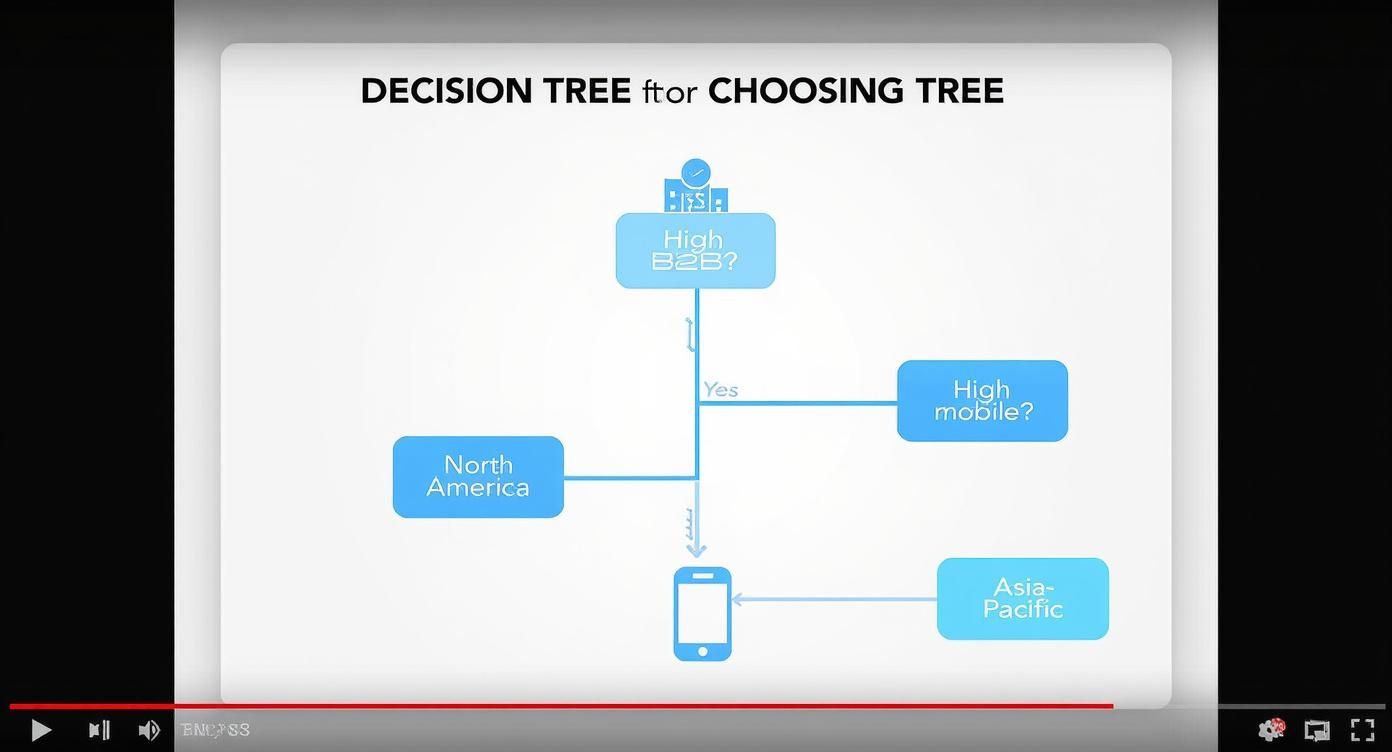
The right gateway can even influence your market strategy. For instance, a gateway with robust B2B invoicing features might be perfect for targeting North America, while one with stellar mobile payment options could be your key to unlocking the Asia-Pacific market.
Don’t underestimate the value of customer support. When payments fail or technical issues arise, responsive and knowledgeable support can be the difference between a minor hiccup and a major revenue disruption.
Can It Grow With You? Scalability Matters
Finally, look to the future. The gateway that’s perfect for you today might hold you back in a year. You need a platform that has a proven track record of growing with businesses. Does it have the advanced features and solid infrastructure to handle a huge spike in transactions without breaking a sweat? Don’t get stuck with a partner that can’t keep up with your success.
Gateway Selection Checklist
To help bring it all together, here’s a quick checklist you can use to compare different gateways side-by-side. Imagine you’re comparing three different types of providers: one with a simple flat rate, one with a more complex interchange-plus model, and one focused on a niche like crypto.
| Consideration | Gateway A (e.g., Flat Rate) | Gateway B (e.g., Interchange+) | Gateway C (e.g., Crypto-focused) |
|---|---|---|---|
| Predictable Pricing? | ✔️ (Very predictable) | ❌ (Varies monthly) | ✔️ (Often a low flat fee) |
| Low-Cost at Scale? | ❌ (Can become expensive) | ✔️ (More cost-effective) | Varies |
| Easy Integration? | ✔️ (Usually has many plugins) | ✔️ (Often requires more setup) | ❌ (Can be highly specialized) |
| PCI DSS Compliant? | ✔️ (Standard) | ✔️ (Standard) | N/A (Different security model) |
| Global Payments? | ✔️ (Good for major currencies) | ✔️ (Excellent for major currencies) | ✔️ (Borderless by nature) |
| Quality Support? | Varies (Often self-serve) | ✔️ (Typically dedicated support) | Varies (Often community-based) |
Using a simple framework like this helps cut through the noise and focus on the criteria that will have the biggest impact on your business's bottom line and operational efficiency.
Still Have Questions? Here Are Some Common Ones
Even after getting the basics down, you're bound to have some practical questions when you're in the weeds of picking and setting up a subscriptions payment gateway. Let's tackle a few of the most common head-scratchers so you can make your next move with confidence.
Can I Use More Than One Gateway?
You bet. In fact, it's often a really sharp move. Running multiple gateways can seriously bump up your payment success rates. If one gateway has a technical hiccup or goes down, your system can automatically reroute the transaction to another one. No more lost sales because of a temporary outage.
This strategy is called payment orchestration. It's not just for backup, either—it lets you get smart about costs by routing specific transactions (like international payments) to whichever gateway offers the best fees for that particular charge.
How Long Does It Take To Get Paid?
This is the big one for cash flow, right? The time it takes for money to travel from your customer's wallet to your bank account is called the settlement period, and it can be all over the map depending on your provider.
- Traditional Gateways: You're usually looking at a wait of 2-3 business days.
- Instant Payout Providers: Some newer players offer instant or same-day access to your funds, but they typically charge an extra fee for the speed.
- Crypto Gateways: This is where things get fast. With crypto, settlement is almost instant. Once the transaction is confirmed on the blockchain—usually a matter of minutes—the funds are yours.
What’s The Difference Between a Payment Gateway And a Merchant Account?
It's easy to get these two mixed up. Let's use a retail store analogy.
The merchant account is like the store's special bank account where all the credit card sales for the day are held before they get transferred to the main business account.
The payment gateway is the actual credit card machine on the counter. It’s the device that securely grabs the card details, encrypts them, and sends the request off for approval. You need both to get paid, but thankfully, most modern payment services bundle them together so you only have to deal with one provider.
Ready to simplify your recurring crypto payments? ATLOS Crypto Payment Gateway offers a no-KYC, direct-to-wallet solution for instant onboarding and complete control over your funds. Start accepting crypto subscriptions seamlessly today at https://atlos.io.