How to Accept Bitcoins for Your Business
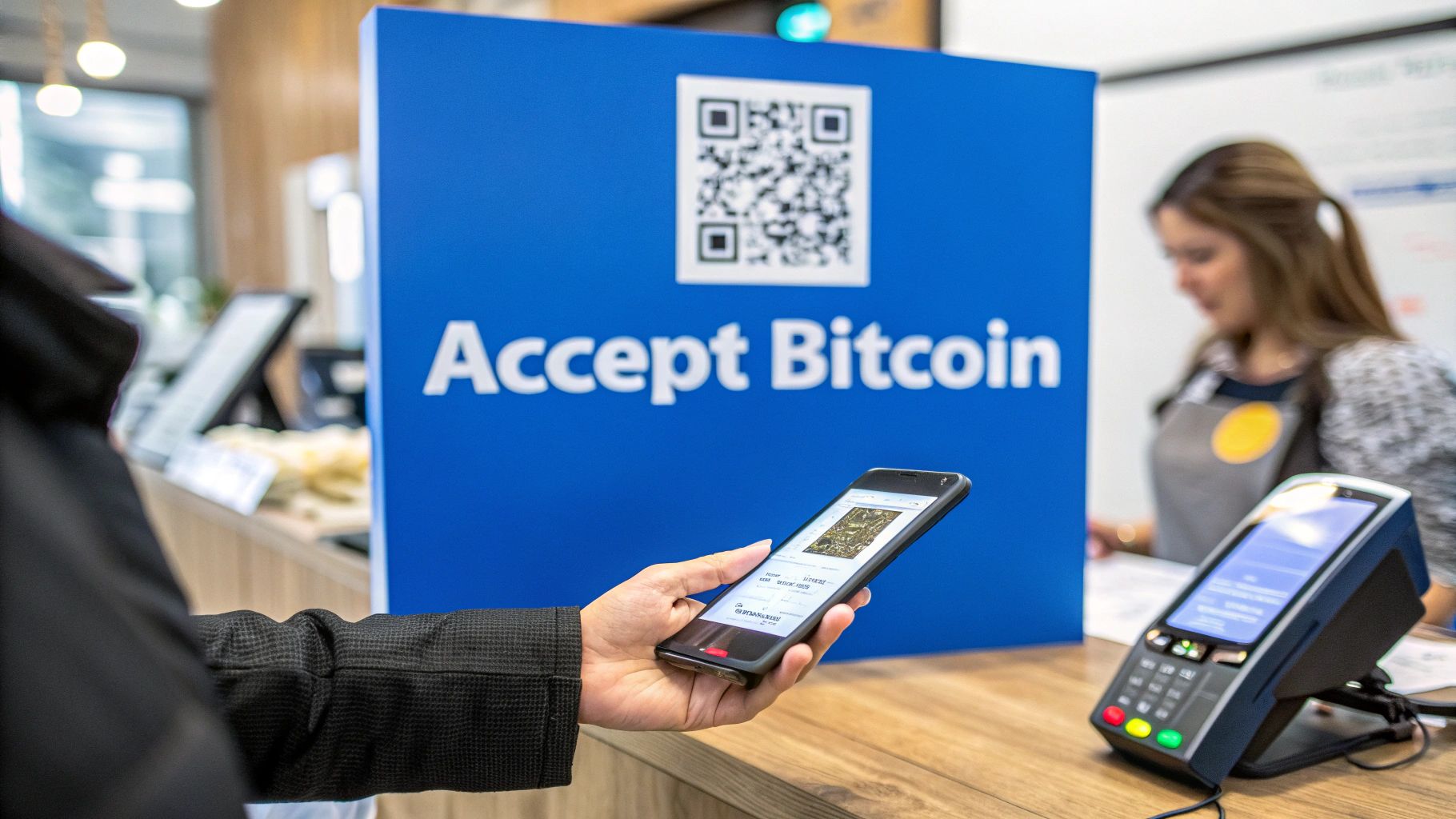
So, you're thinking about accepting Bitcoin. The easiest way to get started is with a payment processor that handles all the complicated stuff behind the scenes. A platform like ATLOS lets you create simple payment buttons or plug directly into your e-commerce store. Best of all, it can instantly convert the crypto into your local currency, so you don't have to worry about price swings.
Why Accepting Bitcoin Is a Smart Move
Before we get into the nitty-gritty of the setup, let’s talk about why this is a genuinely good move for your business. Accepting Bitcoin isn't just a gimmick; it’s a real strategic decision. It opens you up to a growing, tech-savvy customer base that’s actively looking for places to spend their crypto. This is about more than just slapping another payment logo on your checkout page.
For a lot of business owners, the first and most obvious win is financial. We all know that traditional payment fees, especially from credit cards, can be a killer. They chip away at your profits, usually taking 2% to 4% of every single sale. Bitcoin transactions, even when handled by a payment gateway, often come with much lower fees. That means more of your hard-earned money stays where it belongs—with you.
To see the difference in black and white, here's a quick breakdown.
Traditional Payments vs Bitcoin at a Glance
| Feature | Traditional Payments (Credit Cards) | Bitcoin Payments |
|---|---|---|
| Transaction Fees | Typically 2-4% + fixed fees | Often under 1% |
| Settlement Speed | 2-3 business days | Minutes to a few hours |
| Global Reach | Restricted by banking systems & currencies | Borderless, accessible anywhere with internet |
| Chargebacks | Common and costly for merchants | No chargebacks; payments are final |
As you can see, the advantages around cost and speed are pretty compelling on their own.
Unlocking a Global Customer Base
Perhaps the biggest advantage is how easily you can start doing business with anyone, anywhere in the world. Bitcoin isn’t tied to a specific country's banking system, so it completely sidesteps the usual headaches that come with international sales.
This is a game-changer because it means:
- No More Currency Conversion Headaches: You can forget about expensive and confusing currency exchanges. A customer in Japan can pay you just as easily as someone down the street.
- Your Money, Faster: Forget waiting days for international bank transfers to clear. Bitcoin transactions settle much quicker, which is a huge boost for your cash flow.
- Reach Untapped Markets: You can connect with customers in places with limited banking options but widespread internet and mobile phone access.
Bitcoin makes peer-to-peer relief possible. In a country where banks are controlled by the junta and foreign aid is blocked, Bitcoin made direct, unstoppable relief possible. This highlights its power to bypass traditional financial gatekeepers.
Tapping Into a Growing Trend
Let's be clear: cryptocurrency isn't going away. In fact, its adoption is accelerating. As of 2025, global crypto adoption has hit 24%, a noticeable jump from 21% in 2024, with Europe seeing some serious growth. This trend is being fueled by clearer regulations and a growing comfort level with digital assets. For you, that translates to an ever-expanding pool of customers who actually prefer to pay this way.
Diving into regional trends can be really insightful. For example, understanding the cryptocurrency landscape in Hong Kong can give you a better idea of how to position your business in specific markets. By embracing this payment method now, you’re not just adding a new option; you're showing customers that your business is modern, adaptable, and ready for the future.
How to Choose Your Bitcoin Payment Processor
Finding the right partner to process your crypto transactions is probably the most important decision you'll make. This isn’t just about picking a piece of software; you're choosing a service that has to fit with your business goals, your comfort level with the tech, and the kind of experience you want for your customers. A great processor makes everything feel effortless, while the wrong one can cause a lot of headaches.
The number of Bitcoin payment providers out there can feel like a lot to sort through. But don't worry, you can cut through the noise by focusing on a handful of must-have features. Think of this as your shortlist of non-negotiables—each one will have a direct impact on your daily operations, your security, and your profits.
Core Features You Can't Afford to Ignore
When you start comparing options, stick to the fundamentals first. These are the features that really separate the serious, professional-grade services from the more basic ones.
- Instant Fiat Conversion: This is a big one. Bitcoin’s price can swing wildly, and most businesses simply can't stomach the risk of a sudden price drop wiping out their profit margin. A processor that immediately converts Bitcoin payments into your local currency (like USD or EUR) the second a sale is made is your best bet. It completely shields you from volatility, so you get the exact amount you charged, every single time.
- Transparent and Low Fees: Nobody likes surprise fees. Look for a processor with a dead-simple fee structure, usually a flat percentage per transaction. Many of the best providers charge 1% or less, which is a huge savings compared to the typical 2.9% + $0.30 from credit cards. Keep an eye out for hidden costs like setup fees, monthly charges, or steep withdrawal minimums.
- Robust Security Protocols: You’re trusting this provider with your money, so their security has to be top-notch. Make sure they offer industry-standard protections for your account, like two-factor authentication (2FA). It's also wise to check if they use secure practices like cold storage to protect the funds they handle.
There's a well-known saying in the crypto space: "your keys, your crypto." While most processors are custodial (meaning they hold the funds on your behalf), some platforms like ATLOS offer non-custodial solutions. This means payments go directly into a wallet that only you control, giving you ultimate security and power over your own money.
Matching the Processor to Your Business
Every business is different, so a one-size-fits-all solution rarely works. The right choice really comes down to how you operate day-to-day. A simple plugin might be perfect for an online shop, but a consulting firm will need something entirely different.
For E-commerce Stores
If you run an online store on a platform like Shopify, WooCommerce, or Magento, your main priority should be a painless integration. Look for a payment processor that offers a ready-made plugin or a really well-documented API. For a Shopify store owner, the ideal solution is a simple plugin that takes just a few minutes to install. It lets you add a "Pay with Bitcoin" button right on your checkout page without ever touching a line of code.
For Service Providers and Freelancers
When you invoice clients directly for your services, you'll want a processor with a clean, easy-to-use invoicing feature. The goal is to generate a professional-looking invoice that includes a unique payment link or QR code. Your client just clicks the link or scans the code to pay, and the system automatically marks the invoice as paid for you. It takes all the manual tracking off your plate.
For Brick-and-Mortar Businesses
For in-person sales, it’s all about speed and simplicity at the counter. The best setup here is a provider that offers a mobile app or a web-based terminal for your point of sale (POS). This lets you punch in the sale amount and generate a QR code on a tablet or phone. The customer simply scans it with their own crypto wallet, and the payment is done in seconds. The whole process should feel just as quick and familiar as tapping a credit card.
Getting Bitcoin Payments Up and Running in Your Business
Alright, you’ve chosen a processor that seems like a good fit for your business. Now it’s time for the fun part: turning that choice into a working payment system. This is where we get hands-on and connect all the pieces so you can accept your very first Bitcoin payment.
I'm going to walk you through the whole setup, from creating an account to plugging it into your store. Don't worry if you're not a crypto expert; these platforms are designed to be surprisingly straightforward, handling all the complicated stuff behind the scenes.
To make this real, let’s use ATLOS as our example. I find their process is a great representation of what you'll encounter with most top-tier services, and the core steps are pretty much universal.
Setting Up Your Merchant Account
First things first, you need an account. This is usually the quickest part of the entire process, much like signing up for any other online service.
You'll start with the basics: email and a strong password. Right after that, the system will nudge you to set up two-factor authentication (2FA). Do not skip this. It’s a critical security layer that adds a powerful shield to your account, and honestly, it should be non-negotiable for anything involving finances.
Once you’re in, you’ll typically go through a verification process. The requirements can vary based on your location and the processor you chose. Some platforms require detailed business documents to comply with regulations. However, a huge plus for services like ATLOS is their no-KYC (Know Your Customer) approach, which often means you can start accepting payments almost immediately. For businesses eager to get going, this is a massive advantage.
Configuring Payouts and Integrations
With your account live, the next big decision is how you want to get paid. This is where you set up your payout preferences.
Most merchants I work with prefer to have their Bitcoin payments automatically converted into their local currency, like USD or EUR. It’s a smart move that shields you from the price swings of the crypto market. All you have to do is link your business bank account, and the processor takes care of the conversions and deposits for you. Simple.
This flowchart maps out the key things to weigh when picking a processor—balancing features, security, and fees is always the goal.
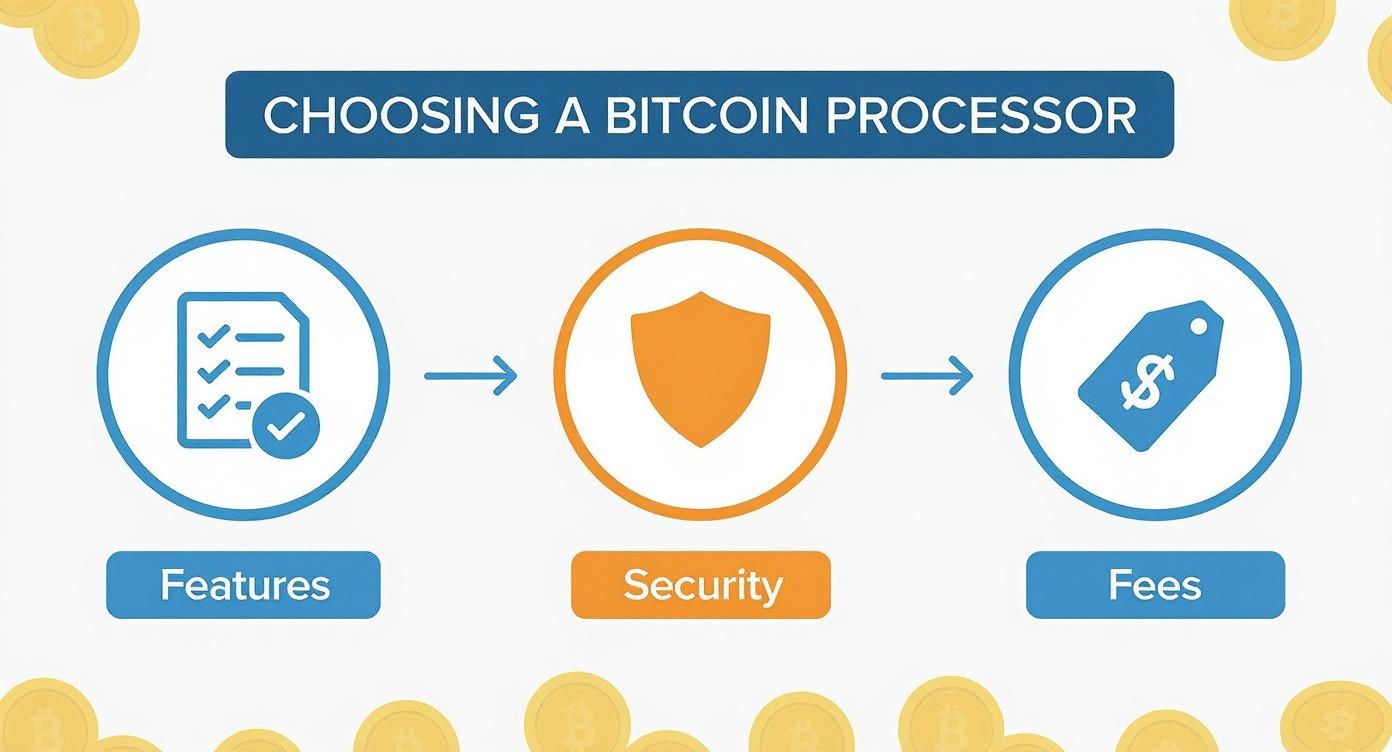 As the visual shows, the best choice for your business lies at the intersection of functionality, solid security, and reasonable costs.
After setting up your bank details, it’s time to integrate the payment system into how you actually sell. This breaks down into two main paths:
- For E-commerce Stores: If you're on a platform like Shopify or WooCommerce, this is a breeze. Most processors offer a dedicated plugin you can install with just a few clicks. The only "technical" part is copying an API key from your processor's dashboard and pasting it into the plugin's settings on your store’s backend.
- For In-Person Sales: Got a brick-and-mortar shop? You'll use the processor's web-based terminal or a mobile app. When a customer is ready to pay, you just type in the purchase amount, and the app generates a unique QR code. They scan it with their Bitcoin wallet, and the payment is done.
The key takeaway here is that modern crypto payment gateways are built for simplicity. The whole process is designed to feel familiar, whether you're adding a payment option online or using a tablet at your checkout counter.
By following these steps, you can get a Bitcoin payment system integrated smoothly and open your doors to a whole new global customer base.
Finding Your Crypto-Ready Customers
So, you've decided to accept Bitcoin. That’s a great first step, but just flipping the switch on a new payment option isn't enough. The real magic happens when you understand who actually wants to pay with crypto and actively go out and find them. This isn't just about processing a transaction; it’s a strategic move to attract a specific, valuable, and often untapped customer base.
Who Is the Modern Bitcoin User?
Let's be clear: the person paying with Bitcoin probably isn't your typical customer. They tend to be early adopters, tech-savvy, and deeply value financial privacy and control. Once you get a handle on what makes them tick, you can tweak your marketing to speak their language.
For example, simply adding a "Bitcoin Accepted Here" logo is one thing. But highlighting it as a feature that shows your business is forward-thinking and respects customer privacy? That’s a signal that you get it, and it builds instant rapport. You're showing them your brand aligns with the very principles of innovation and autonomy that they champion.
The numbers back this up. In 2024, global crypto ownership hit 6.8%. Drilling down, you'll find that 61% of owners are male and 39% are female. What’s really interesting for most businesses is that a huge chunk—34%—are between the ages of 25 and 34. In a major market like the United States, that adoption rate jumps to 15.56%. If you want to dive deeper, check out the global cryptocurrency ownership data on triple-a.io.
Knowing your audience is marketing 101, but in the crypto space, it's even more crucial. These aren't just customers; they are participants in a new economy. They actively seek out merchants who support their financial choices, turning a simple payment option into a powerful loyalty driver.
Identifying Global Hotspots and Emerging Markets
One of the most powerful things about Bitcoin is that it's borderless. Suddenly, you can tap into international markets without getting tangled up in the usual headaches of cross-border banking. The trick is figuring out where crypto adoption is really taking off.
And don't just think of the usual suspects. While places like the U.S. and parts of Europe have strong crypto communities, some of the most exciting growth is happening in unexpected corners of the world. Often, regions dealing with economic instability or that have large unbanked populations are seeing massive crypto adoption out of sheer necessity.
Here’s how you can turn that knowledge into customers:
- Targeted Digital Advertising: When you set up your next ad campaign, use geo-targeting to focus on countries with high crypto ownership. Your "We Accept Bitcoin" message will resonate far more strongly there than in a market where adoption is low.
- Community Engagement: Don't just advertise; participate. Hang out in crypto-focused subreddits or on X (formerly Twitter). Get involved in conversations, understand what users in different countries need, and casually let them know your business is an option.
- Localize Your Content: Found a promising market? Translating a few key pages on your website is a simple but powerful gesture. It shows international customers you’re serious about welcoming their business.
By zeroing in on these crypto-ready customers, you're doing much more than just adding another payment button. You're executing a smart, calculated global expansion strategy, opening your doors to a motivated audience that is actively looking for businesses like yours.
Security and Customer Trust Best Practices
When you start accepting Bitcoin, your top priority should be building a rock-solid process that protects your funds and makes your customers feel safe. It all starts with the tools you choose. For instance, picking a reputable processor like ATLOS gives you a foundation of strong encryption and transparent fee handling right out of the gate. This isn't just about preventing fraud; it’s about earning the confidence that turns a one-time buyer into a loyal customer.
Think of your payment processor as the bedrock of your security strategy. Once that's in place, the next step is adding layers of protection on top. Activating two-factor authentication (2FA) is non-negotiable—it's your first line of defense. After that, it’s all about smart wallet management to keep your crypto assets secure.
Two-Factor Authentication Setup
Flipping the switch on 2FA means that every login will require a second form of approval beyond just the password. You can use SMS codes, but I always recommend using an authenticator app like Google Authenticator or Authy for much better security. It's a simple step that stops an attacker in their tracks, even if they manage to get ahold of your password.
“Two-factor authentication blocks over 90% of automated attacks.”
Wallet Management Tips
Smart wallet management is a balancing act between having funds ready for day-to-day operations and keeping the bulk of your assets locked down. The standard practice is to use a "hot wallet" (one connected to the internet) for small, frequent transactions. For anything else—your main reserves—you'll want to move it to a "cold wallet" that’s kept completely offline.
And please, don't forget to back up your wallet's seed phrase. Write it down and store it somewhere incredibly safe and offline. Losing that phrase means losing your funds, period.
| Store Type | Access Speed | Security Level |
|---|---|---|
| Hot Wallet | Instant | Medium |
| Cold Wallet | Delayed | High |
Now, securing your end is only half the battle. You also need to communicate that security to your customers. People can be hesitant about paying with crypto if they don't understand the process. A little transparency goes a long way and can actually become a selling point.
Communicating Payment Security
Don't assume your customers know how Bitcoin payments work. Create a simple guide or an FAQ section that walks them through it. Point out the benefits, like instant payment confirmations and the finality of transactions, so they know what to expect. I've found that a short video or even a few screenshots of the checkout process can demystify the experience and make people much more comfortable hitting "pay."
- Show, don't just tell. A simple diagram of the checkout flow can work wonders.
- Add visual trust signals. Place trust badges and your payment processor's logo on the checkout page.
- Be available. Offer a specific support channel (email or chat) just for crypto-related payment questions.
“Our clients reported a 30% increase in conversion rates after adding clear Bitcoin payment instructions.”
Final Security Checklist
Before you go live, run through this final checklist. It’s what I use to make sure all the bases are covered.
- Confirm that two-factor authentication is active on every single account associated with your payments.
- Double-check that your wallet seed phrase is stored securely offline.
- Do a complete test run of the payment process. See it from the customer's eyes.
- Set a recurring calendar reminder to review your processor logs and any security updates monthly.
- Make sure all your software, plugins, and apps are running the latest versions.
Staying on top of these small details and being open with your customers is how you build a payment system people trust.
Frequently Asked Questions About Accepting Bitcoin
Diving into crypto payments often sparks a few practical questions. Below, you’ll find clear, experience-driven answers to the top concerns we hear from business owners making the jump into Bitcoin.
Think of this as your crash course on the essentials—from setup basics to real-world tips for managing payments and risks.
Do I Need To Be A Tech Expert To Accept Bitcoin?
Absolutely not. Most Bitcoin payment processors handle the heavy lifting behind the scenes.
You’ll benefit from:
- A straightforward dashboard to generate invoices or embed payment buttons
- Automatic transaction processing without touching blockchain code
- Support teams ready to guide you through any hiccups
In practice, you spend minutes configuring your account and choosing how you’d like funds delivered—just like setting up a credit card gateway.
How Do I Handle Bitcoin Price Volatility?
Price swings can feel intimidating, but you don’t have to sit on that roller coaster.
Most gateways offer instant conversion to your preferred currency (USD, EUR, etc.). The moment a customer pays in Bitcoin, the system locks in the rate and deposits the exact amount you’ve invoiced.
Here’s what that looks like in action:
- Customer pays 0.015 BTC for a $200 purchase
- Processor converts at that second’s exchange rate
- You receive $200 directly in your bank account
No extra steps, no exposure to crypto market gyrations.
Is Accepting Bitcoin Secure For My Business?
Handled correctly, Bitcoin can be safer than many traditional methods. Transactions are final—no chargebacks, and fraud risk plummets.
“Choosing a reputable processor with two-factor authentication and secure fund storage is your first line of defense.”
Best practices include:
- Enabling two-factor authentication on all accounts
- Routing funds to a cold wallet if you hold crypto internally
- Monitoring transaction logs for any unusual activity
Those steps cover most of your security needs, letting you focus on growth instead of worrying about fraud.
Global Crypto Adoption Snapshot
Understanding where Bitcoin is catching fire can shape your expansion plans. The 2025 Global Crypto Adoption Index highlights these leaders:
| Country | Rank In Index |
|---|---|
| Ukraine | 1 |
| Moldova | 2 |
| Georgia | 3 |
| India | 4 |
| United States | 5 |
Explore more insights about global crypto adoption at Chainalysis.com.
What Are The Tax Implications Of Accepting Bitcoin?
Tax rules vary, but a common approach treats Bitcoin as property. If your processor swaps Bitcoin into local currency instantly, your bookkeeping stays familiar—you record sales in your regular books.
However, holding Bitcoin on your balance sheet introduces potential capital gains or losses when you sell. My advice:
- Consult a crypto-savvy tax professional
- Keep clear records of conversion dates and amounts
- Separate your business accounting from any personal crypto holdings
Ready to start accepting Bitcoin with zero hassle and no KYC? ATLOS offers a direct-to-wallet gateway that puts you in control. You’ll be up and running in minutes, tapping into the global crypto economy with confidence.