Your Guide to White Label Payment Gateway Providers
So, what exactly is a white label payment gateway provider?
Think of it like this: a top-tier craft brewery creates an amazing new beer, but instead of bottling it under their own name, they let a local pub put it on tap and call it their own "house brew." The pub gets a fantastic, ready-to-serve product, and their customers get a seamless experience, never knowing about the master brewer behind the scenes.
That's the same principle. A white label provider builds a powerful, secure payment processing system, and then lets other businesses put their own brand on it. This lets companies offer sophisticated payment services without spending years and millions of dollars building the technology from the ground up.
Getting to the Core of White Label Payments
At its heart, a white label payment gateway is all about partnership. One company handles the tough stuff—building and maintaining the complex, compliant, and secure payment technology. Another company (that’s you!) licenses that tech and presents it to customers as a fully branded part of their own service.
Your customer only sees what you want them to see: a payment page with your logo, your colors, and your messaging. They get a smooth, trustworthy checkout that feels completely integrated with your business. This builds confidence and reinforces your brand, while the provider does all the technical heavy lifting in the background.
Who's Who in the White Label World
This model really comes down to three key players, each with a specific job to do:
- The Provider: This is the tech expert (like us at ATLOS) that develops, maintains, and updates the core payment gateway. They're the ones responsible for rock-solid security, compliance, and all the backend functionality.
- The Business (You): You're the one licensing the technology. Your job is to customize the gateway's look and feel, integrate it with your platform, and manage the entire relationship with your own merchants or customers.
- The End-Customer: This is the person actually making the payment. To them, the entire experience is with your brand. They usually have no idea a white label provider is even involved.
It's a structure that's catching on fast. The global market for these customizable payment solutions is set to explode, growing from USD 2.02 billion in 2025 to USD 4.08 billion by 2030. This incredible growth shows just how many businesses are turning to this model to get into the payments game quickly. You can read the full research about the white label payment gateway market to dig deeper into the numbers.
A white label gateway separates the customer-facing brand from the complex technology running underneath. It lets you own the customer relationship and control the entire user journey, without the massive financial and regulatory headache of becoming a certified payment processor yourself.
By going with a white label solution, you can launch your own branded payment service in a tiny fraction of the time and cost it would take to build one from scratch. It’s a huge strategic advantage that frees you up to focus on what you do best—growing your business and serving your customers—while leaving the payment plumbing to the experts.
The Strategic Benefits of a White Label Partner
Choosing a white-label payment gateway isn't just a technical fix; it's a core business decision that can give you a serious leg up on the competition. The most obvious win is how fast you can get to market. Trying to build a payment gateway from scratch is a massive undertaking—we're talking years of development and a budget that can easily run into hundreds of thousands, if not millions, of dollars for coding, legal, and compliance work.
A white-label partnership lets you skip all of that. Think about an independent software vendor who wants to add payment processing to their platform. Instead of getting bogged down in a multi-year development nightmare, they can plug in a ready-made solution and have a new, branded revenue stream up and running in a few weeks.
That speed is just the beginning. The market itself tells a compelling story. Valued at USD 5.4 billion in 2024, the white-label payment gateway space is expected to more than double to USD 12.7 billion by 2033. This isn't just a trend; it's a clear signal that businesses are moving toward smarter, more efficient ways of operating. Discover more insights about white label gateway market growth.
Strengthen Brand Trust and Ownership
One of the biggest advantages is keeping your customer experience consistent. Nothing breaks the flow of a purchase like being redirected to some unfamiliar third-party site to enter credit card details. It feels clunky and can make customers second-guess the transaction.
A white-label solution keeps everything under your own brand and within your own environment. You control the entire process, which goes a long way in building customer confidence right at the moment it matters most. It's your brand, your interface, your relationship from start to finish.
A white label gateway empowers you to own the entire customer experience. By keeping payments under your brand, you eliminate friction and build the kind of trust that turns one-time buyers into loyal customers.
Reduce Costs and Reallocate Resources
The savings go far beyond just avoiding those initial development costs. Running a payment system is a constant drain on resources. You have to stay on top of security patches, software updates, and grueling compliance audits. It’s a full-time job for a specialized team.
When you work with a white label payment gateway provider, you hand off all that heavy lifting. This frees up your best people—your internal teams—to focus on what truly grows your business: making your core product better and keeping customers happy. Your developers can stop worrying about payment infrastructure and start building features your users actually want. That simple shift can be the most powerful benefit of all, turning a necessary expense into a driver for real growth.
How to Choose the Right Payment Gateway Provider
Picking the right white label payment gateway provider isn't just a tech decision—it’s a strategic partnership. This choice will directly shape your business's ability to grow and succeed. The best partner gives you more than just software; they hand you a secure, reliable, and adaptable foundation so you can own the entire customer experience. It’s about digging past the sales pitch and asking the right questions.
Before we get into the nitty-gritty, let's look at what this kind of partnership really unlocks.
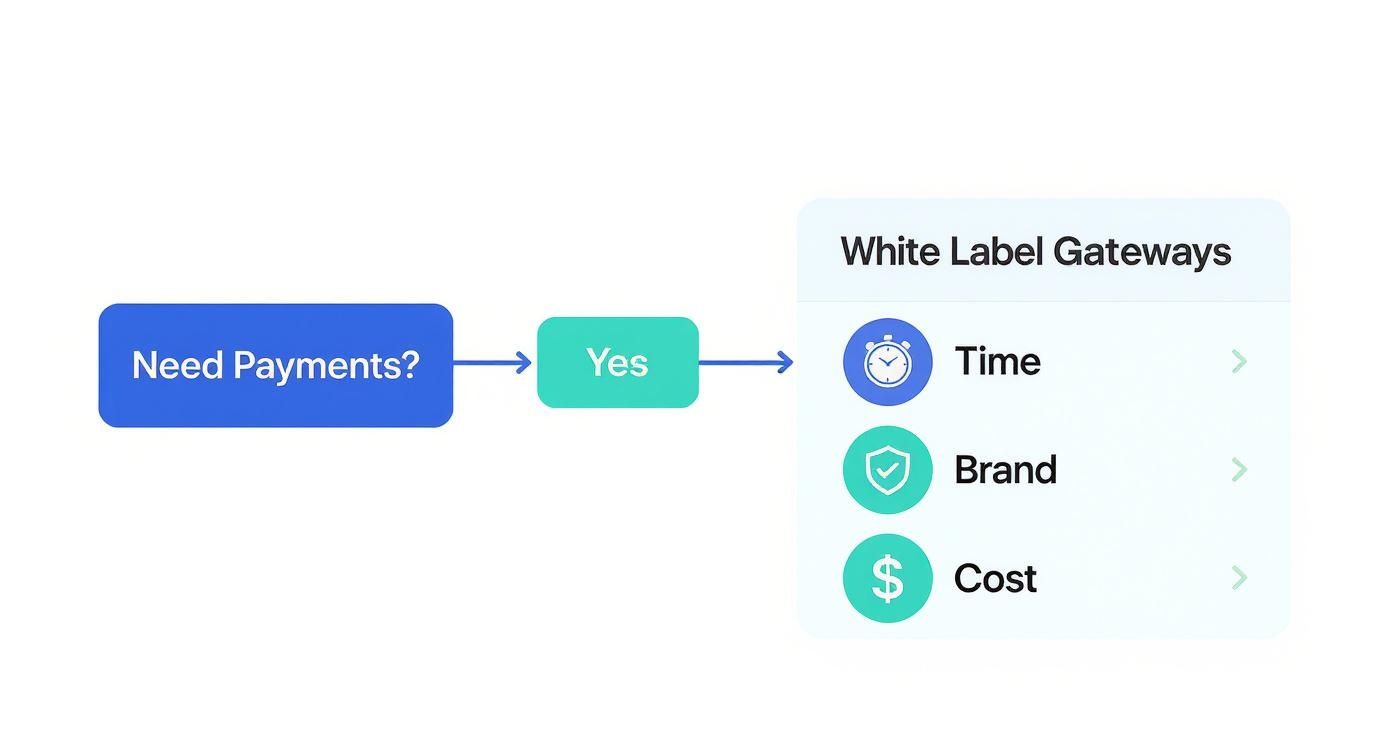
This decision tree gives you a clear picture. The need to process payments can lead you down a path that saves you time, gives you full brand control, and makes financial sense—which are the core strengths of a white-label model.
Prioritize Ironclad Security and Compliance
When it comes to payments, security is everything. It's not negotiable. You're handling your customers' most sensitive data, and a single breach can shatter the trust you’ve worked so hard to build. So, your very first filter should be security standards.
Make sure any provider you consider is PCI DSS Level 1 certified. This is the highest, most rigorous level of compliance from the Payment Card Industry Data Security Standard. It’s a clear sign that their systems have been put through the wringer to ensure cardholder data is protected. But don't stop there. Ask about their fraud prevention toolkit—things like real-time transaction monitoring, custom risk rules, and support for 3D Secure authentication.
Diving deeper, it's worth understanding key compliance certifications like ISO 27001 and SOC 2 as well. These aren't just acronyms; they prove a provider's serious commitment to maintaining bulletproof information security systems.
A provider's security posture is a direct reflection of their reliability. Don't just ask if they are compliant; ask them to detail the specific tools and processes they use to protect your business and your customers from emerging threats.
Evaluate Customization and Branding Flexibility
Let's be honest, the whole point of going "white-label" is to make it feel like your solution. A truly great provider gives you the tools to create a payment experience that is indistinguishable from your own brand. We’re talking about much more than just slapping your logo on a checkout page.
Your evaluation checklist should include:
- Complete UI/UX Control: Can you change everything? I mean colors, fonts, field layouts, and messaging, so the checkout feels like a natural part of your app.
- Hosted Payment Pages: Do they offer hosted payment pages that are fully brandable? This is a huge win, as it takes much of the PCI compliance burden off your shoulders without sacrificing your brand’s look and feel.
- API-Driven Customization: For those with a strong dev team, does their API give you the freedom to build a completely unique payment flow from scratch?
The end goal is a customer journey that feels seamless and unified. When the platform is truly flexible, you can maintain brand consistency at every single touchpoint, which builds trust and ultimately lifts conversion rates.
Scrutinize Technical Scalability and Support
You’re building your business to grow, and your payment infrastructure has to be ready to scale right alongside you. This is where a provider’s technical chops become critical for your long-term health. Ask them about their system's architecture, their uptime guarantees (you should be looking for 99.9% or higher), and how they handle sudden traffic spikes without breaking a sweat.
Just as crucial is the quality of their developer support and API documentation. Clean, clear documentation can shave weeks off your integration time. And when you inevitably hit a snag, having responsive and knowledgeable tech support is priceless. A provider who invests in their developer experience is a provider who is invested in your success.
To help you keep track of these critical elements, here’s a quick checklist to use when you're comparing potential partners.
Provider Selection Checklist Essential Features
This table breaks down the must-have features into key categories, helping you ask the right questions and compare providers apples-to-apples.
| Feature Category | What to Look For | Why It Matters |
|---|---|---|
| Security & Compliance | PCI DSS Level 1, advanced fraud tools, ISO/SOC certifications | Protects customer data, builds trust, and reduces your liability. |
| Branding & Customization | Fully customizable UI/UX, hosted payment pages, robust API | Ensures a seamless brand experience, which improves customer trust and conversion rates. |
| Scalability & Reliability | High uptime guarantees (99.9%+), proven volume handling | Your payment system needs to grow with your business and be available 24/7. |
| Developer Experience | Clear API documentation, responsive technical support, sandbox environment | A smooth integration saves time and money, and good support is critical for troubleshooting. |
| Payment Methods | Support for all major credit cards, ACH, digital wallets (Apple Pay, etc.) | Offering customers their preferred way to pay is essential for maximizing sales. |
| Reporting & Analytics | Real-time dashboards, detailed transaction reporting, dispute management tools | Gives you the data you need to make smart business decisions and manage operations. |
Using this framework ensures you cover all your bases, from the foundational security requirements to the finer points of developer support. A thoughtful evaluation now will pay dividends for years to come.
The Must-Have Features for Your White Label Gateway
Once you have a shortlist of potential partners, it’s time to get into the weeds and look at what they actually offer. Not all white label payment gateway providers are built the same, and the right feature set is what separates a decent platform from one that truly fuels your growth. These aren't just flashy add-ons; they're the core tools that impact your revenue, keep customers happy, and give you an edge.
Think of it like building a house. You can't start hanging pictures before the foundation is poured. These essential features are that foundation—they ensure you can meet customer demands right now and scale up when you're ready.
Global Reach and Payment Flexibility
To have any real shot at competing, your gateway has to handle all the ways people want to pay. If you force customers into just one or two options, you're practically inviting them to abandon their carts.
A solid platform should absolutely include:
- Multi-Currency Processing: If you have any plans to sell internationally, being able to accept and settle payments in different currencies is non-negotiable. It makes life easier for your global customers and cleans up your own accounting.
- Wide-Ranging Payment Methods: This is about more than just Visa and Mastercard. You need to support the big digital wallets like Apple Pay and Google Pay, direct bank transfers (ACH), and any local payment methods that are popular in your key markets.
This kind of flexibility is a game-changer. When you let customers pay how they want, you drastically improve your chances of closing the sale.
Advanced Security and Fraud Prevention
In the world of payments, security is everything. Your provider needs to go way beyond basic compliance. They need a deep, multi-layered strategy to protect you, your business, and your customers.
A top-tier white label gateway doesn't just move money—it protects it. Features like tokenization and 3D Secure aren't nice-to-haves; they are the fundamental building blocks of a trustworthy payment experience.
Tokenization is a perfect example. It's a clever process that swaps sensitive credit card details for a unique, meaningless token. This means you can handle recurring payments without ever letting raw card numbers touch your servers, which dramatically shrinks your PCI compliance burden and your risk. Then there's 3D Secure, which adds that extra verification step for online card payments to stop fraudulent chargebacks in their tracks.
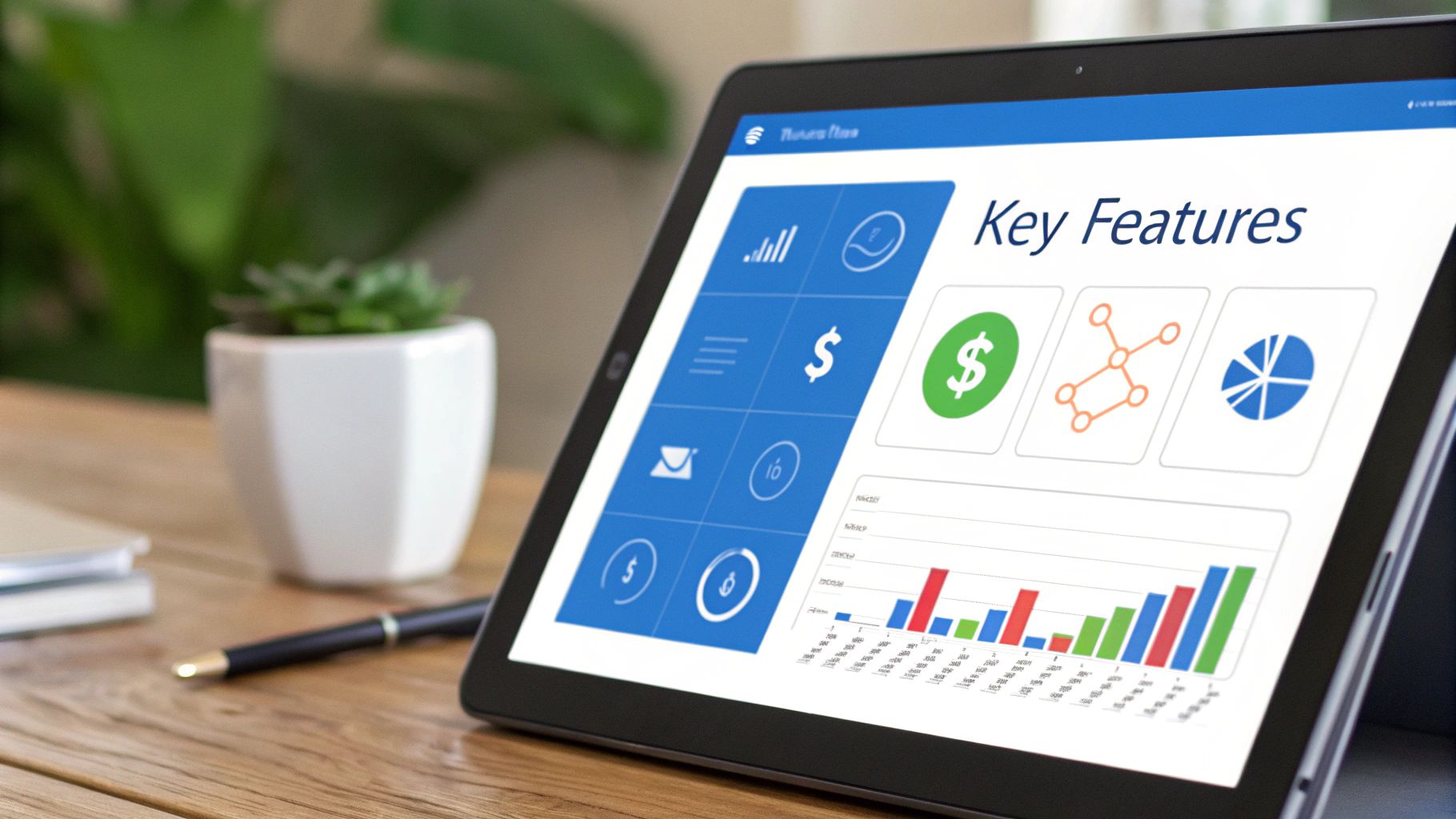
On top of that, a good provider will give you a powerful analytics dashboard. This is your mission control for payments, offering a live look at transaction trends, approval rates, and customer habits. With that data, you can fine-tune your checkout process, spot problems early, and make smart decisions that directly impact your bottom line.
These are the kinds of features that really show how white label gateways can lower the barrier to entry for businesses wanting to offer payment services. You can read more about the white label payment gateway market to get a sense of its growing impact.
Integrating Your Branded Payment Experience
So, you’ve picked your white-label payment gateway provider. Now comes the fun part: taking their powerful technology and making it completely your own. If that sounds a bit daunting, don't worry. Modern APIs and Software Development Kits (SDKs) are built to make this process much smoother than you'd think for your development team.
The first step is getting your developers set up. Your provider will give you access to a sandbox environment. Think of it as a secure playground where you can build and test everything without touching real money or live customer data. In this sandbox, your team will get their API keys—the special credentials that let your software talk to the gateway.
This initial phase is all about experimenting safely. It’s the perfect place to run through transaction flows, mimic different payment outcomes, and just make sure all the technical plumbing is connected correctly before you move on.
Applying Your Brand's Identity
Once the technical groundwork is laid, the real creative work begins. This is where you weave your brand’s look and feel into every part of the payment process. The aim is to create something so smooth and consistent that your customers don't even realize they're interacting with a third-party tool.
To get this right, it's crucial for your team to understand things like API design best practices. This knowledge ensures the communication between your platform and the gateway is not just secure, but also efficient and reliable. It’s the key to building a payment flow that’s both visually on-brand and technically solid.
A great white-label integration is more than just slapping your logo on a checkout page. It’s about fine-tuning every detail—from the color of a button to the tone of an error message—to match your brand's voice and earn customer trust at the most critical moment.
During this stage, you'll customize the core user interface and experience. A good provider will give you the flexibility to control elements like:
- Color Schemes: Match the checkout page perfectly to your brand’s palette.
- Logos and Fonts: Keep the visual style consistent with the rest of your site or app.
- Layout and Fields: Customize the payment form to collect only what you need, making checkout faster and simpler for your customers.
Launching with Confidence
Before you go live, rigorous testing is absolutely essential. Your team should put the integration through its paces in the sandbox environment, simulating everything from successful payments and declined cards to unexpected errors. This process ensures the experience is predictable and professional for every customer, no matter what happens.
When you're completely satisfied with how everything looks and works, it's time for the final flip of the switch: moving from the sandbox to the production environment. This is usually as simple as swapping the test API keys for your live ones. Just like that, your fully branded, seamlessly integrated payment gateway is up and running, ready to process real transactions.
Remember, throughout this whole journey, good documentation and quick support from your provider are your best friends. They can make the difference between a frustrating delay and a quick, successful launch.
Still Have Questions About White Label Gateways?
Diving into the world of branded payment services is a big step, but it's probably less complicated than you think. Even after you've weighed the benefits, a few questions might still be lingering. Let's tackle some of the most common ones to clear things up so you can move forward confidently.
White Label vs. Standard Gateways
So, what's the real difference here? It all boils down to branding and control.
When you use a standard gateway like PayPal or Stripe, your customers know it. They’re often sent to a PayPal or Stripe-branded page to complete their payment, which can pull them out of your carefully crafted user experience.
A white-label payment gateway is the complete opposite. It lets you process every single transaction under your own brand. The customer never leaves your environment, which creates a seamless, trust-building experience from start to finish. You're essentially leasing the powerful backend technology while putting your own brand front and center.
Who's on the Hook for Security and PCI Compliance?
This is a big one. The short answer is: your provider handles the heavy lifting. The white-label provider is responsible for maintaining the core infrastructure's security and its PCI DSS Level 1 compliance. They’re the ones managing data encryption, building the secure environment, and going through all the intense audits.
This is a massive advantage. It takes a huge operational and financial weight off your shoulders. While you still need to ensure your own systems are secure, the foundational compliance and its immense costs are handled by the provider.
What's the Real Cost?
Okay, let's talk money. Pricing models do vary, but they usually have a few standard parts. You can generally expect a one-time setup fee, a recurring monthly or annual license fee, and a small fee for each transaction. Some providers also offer tiered pricing that gets cheaper as your transaction volume grows.
While it’s an investment, it’s a fraction of the multimillion-dollar price tag and years of development it would take to build a compliant gateway from the ground up. Before you sign anything, always ask for a complete fee schedule to understand the total cost of ownership and avoid any hidden surprises.
How Long Does It Take to Get Up and Running?
This is where the white-label model really shines. Building a payment gateway from scratch is a multi-year project, no question about it.
In contrast, you can integrate a white-label solution in just a few weeks to a few months. The exact timeline depends on how complex your needs are and how good the provider's API and documentation are. A partner with solid developer support and clear guides will get you to market so much faster.
Ready to take full control of your payment experience without the technical headaches? ATLOS provides a powerful, secure, and fully customizable crypto payment gateway that puts your brand first. Start processing payments almost instantly with our no-KYC, direct-to-wallet solution. Explore the ATLOS white label solution today.