Your Guide to High Risk Payment Gateways
Think of your standard, everyday payment gateway as a smooth, well-lit highway. It's perfect for the usual traffic of online stores. A high-risk payment gateway, on the other hand, is like a custom-built, all-terrain vehicle designed to handle rough, unpredictable landscapes. It’s a specialized payment solution for businesses that traditional banks and processors find too risky.
Why the caution? It usually boils down to higher chances of chargebacks, fraud, or tricky regulations.
So, What Does "High Risk" Actually Mean?
At its heart, a high-risk payment gateway is the crucial link that securely handles payment data for businesses in financially volatile industries. This "high-risk" tag isn't a knock on your business's quality or integrity. It’s simply a financial calculation based on historical data and common transaction patterns within certain sectors.
Let’s put it this way: a standard processor like Stripe or PayPal thrives on predictability. They love businesses with low chargeback rates and straightforward products. The moment a business model introduces variables that could cause financial loss—think disputed charges, regulatory fines, or high return rates—these mainstream processors tend to get nervous and back away.
That’s exactly where a high-risk gateway finds its purpose. It's built from the ground up with more robust tools and a tougher underwriting process to manage the financial uncertainties that come with the territory.
Why Do Banks Label a Business "High Risk"?
The classification all comes down to a bank's appetite for financial risk. To really get it, you need a basic grasp of modern banking risk assessment. Several key factors will get your business flagged:
- Your Industry: Some business types are automatically considered high-risk. Think of industries like online gaming, CBD sales, adult entertainment, and dietary supplements. They often face much higher rates of fraud and chargebacks, sometimes topping 2.5%, while the average e-commerce store stays well under 1%. You can dig deeper into the evolving payments ecosystem at clearlypayments.com.
- How You Bill: If you use a subscription or recurring billing model, you're more likely to see "friendly fraud"—cases where a customer simply forgets about a recurring charge and disputes it.
- High Ticket Prices: Selling high-value items? Businesses dealing in luxury goods, travel packages, or expensive electronics are riskier because a single chargeback can mean a huge financial hit.
- Selling Globally: Accepting international payments brings a host of complexities, from currency conversions to navigating different banking laws, all of which open the door to more potential fraud.
In short, being labeled 'high risk' means your business operates in a financial arena where the potential for transaction disputes, fraud, and regulatory headaches is much higher than usual. A specialized gateway is your map and your armor in this environment.
Ultimately, a high-risk gateway is more than just a piece of tech; it’s a strategic partner. It gives you the essential infrastructure—from sophisticated fraud filters to hands-on chargeback management—that allows your business to not just survive but thrive where standard solutions can't operate. Without them, entire sectors of the economy would be locked out of online commerce.
Does Your Business Need a High-Risk Gateway?
Figuring out if you need a high-risk payment gateway can feel a bit murky. It’s not always as simple as being in an industry with obvious red flags. More often than not, the "high-risk" label comes from the subtle details of your business model—the very things that signal potential financial instability to payment processors.
While the type of industry you're in is a big piece of the puzzle, processors look much deeper. They want to understand your business's operational DNA, scrutinizing everything from your billing methods to the average price of your products. Getting a handle on these factors is the key to seeing your business through their eyes and getting ahead of the application process.
This decision tree gives you a good visual of how that initial assessment often plays out.
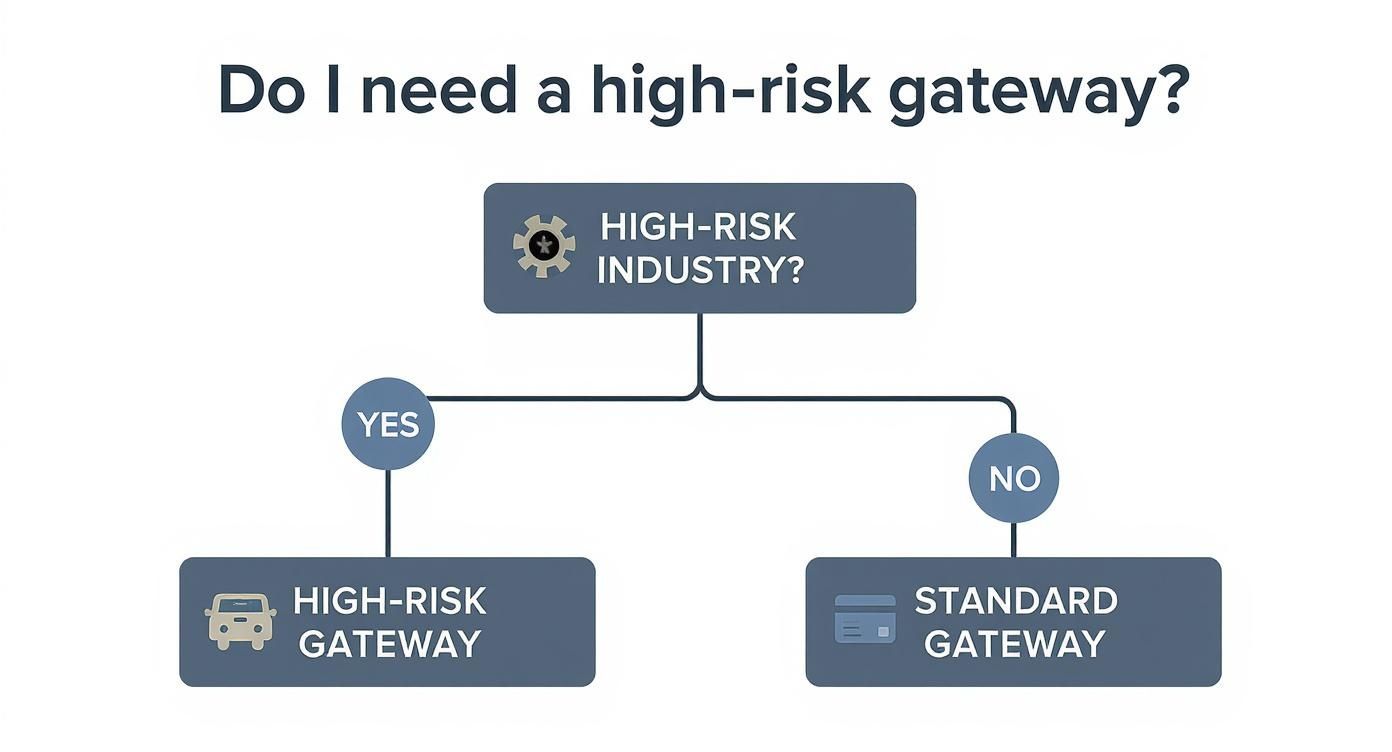
As you can see, operating in a designated high-risk industry is the most direct path to needing a specialized gateway, but it's certainly not the only one.
Key Factors That Define a High-Risk Business
Even if your industry seems safe, certain business practices can land you in the high-risk category all on their own. If your business model involves any of the following, you'll almost certainly need a high-risk payment gateway, regardless of what you sell.
At the end of the day, all of these factors point to one crucial metric for processors: the likelihood of chargebacks.
- High Average Transaction Value: Selling big-ticket items? Think furniture, high-end electronics, or vacation packages. A single chargeback on a $2,500 sofa is a much bigger financial hit than one on a $25 t-shirt, and that makes processors nervous.
- Recurring Billing Models: Subscription services are everywhere, from monthly snack boxes to SaaS platforms. The problem is, they're a magnet for "friendly fraud." That’s when a legitimate customer either forgets about a recurring charge or doesn’t recognize it on their statement and files a dispute.
- International Sales: Selling to a global audience is fantastic for growth, but it introduces a host of complexities. You're suddenly dealing with fluctuating currencies, different international banking laws, and a much higher chance of cross-border fraud. All of this adds up to more risk.
- A History of High Chargebacks: This one's a biggie. If your business has a track record of chargeback rates above the industry standard (usually around 0.9%), you'll be classified as high-risk, no questions asked. For acquiring banks, your past performance is the best predictor of their future risk.
A business isn’t just what it sells; it’s how it sells. Processors evaluate your entire transaction lifecycle—from the price point to billing frequency—to calculate their potential financial exposure. This holistic view determines your risk classification.
To help clarify the distinction, let's look at a side-by-side comparison of what processors typically consider low-risk versus high-risk.
Low Risk vs High Risk Merchant Profile Comparison
| Characteristic | Low-Risk Business Profile | High-Risk Business Profile |
|---|---|---|
| Industry | Sells common retail goods (e.g., clothing, books) | Operates in regulated or controversial verticals (e.g., CBD, gaming) |
| Avg. Ticket Price | Low (typically under $50) | High (often $500 or more) |
| Billing Model | One-time transactions | Recurring subscriptions or memberships |
| Sales Territory | Primarily domestic (single country) | Significant international sales |
| Chargeback History | Consistently below 0.9% | History of exceeding the 0.9% chargeback threshold |
| Fulfillment Time | Immediate or within a few days | Delayed delivery (e.g., travel bookings, pre-orders) |
This table shows how seemingly small operational differences can completely change how a payment processor views your business's risk profile.
Common High-Risk Industries
While business practices are a major factor, some industries are almost automatically flagged as high-risk because of what they sell or the heavy regulations they operate under. Processors keep close tabs on these sectors because they consistently produce more disputes and fraud.
If your business is in one of these areas, you should plan on needing a high-risk payment solution right from the start.
- CBD and Nutraceuticals: Products making health claims that aren't necessarily backed by the FDA are ripe for customer disputes over their effectiveness.
- Adult Entertainment: This industry has always struggled with high chargeback rates and reputational concerns from mainstream financial institutions.
- Online Gambling and Gaming: A perfect storm of high-volume transactions, a global customer base, and tight regulations make this a classic high-risk industry.
- Firearms and Accessories: Heavy legal and age-related restrictions mean businesses selling these products need processors who specialize in this vertical.
- Subscription Boxes: As we mentioned, the recurring billing model is the main culprit here, leading to a high rate of friendly fraud.
Ultimately, figuring out that you need a high-risk payment gateway is the first critical step toward building a payment system that can actually support your business. When you understand how processors see you, you can find a partner who is truly equipped to handle your specific needs, ensuring you can keep accepting payments without a hitch.
What to Look For in a High Risk Gateway
Not all payment gateways are built the same, especially when you're operating in a volatile market. Think of a standard gateway as a reliable family sedan—great for everyday trips. A high risk payment gateway, on the other hand, is more like an armored truck. It’s purpose-built with specialized tools to handle serious threats and keep your business running.
This isn't just about processing payments. It’s a complete system designed to protect your revenue, cut down on manual work, and maintain a healthy relationship with your acquiring bank.
Knowing what features are non-negotiable is the key to picking the right partner. These aren't just nice-to-haves; they are the core components that allow you to operate securely and without interruption in a high-stakes environment.
Advanced Fraud Detection and Prevention
For any high-risk merchant, your first line of defense is a powerful fraud prevention suite. Basic tools that just check CVV codes and addresses simply won't cut it. A top-tier high risk gateway uses a multi-layered security approach to stay ahead of trouble.
The technology in this space is moving fast, and today, AI-driven fraud detection is a must. Old, rules-based systems are too slow and predictable to keep up with sophisticated criminal tactics. Modern fraud tools combine machine learning with massive global data networks to spot and block bad transactions in milliseconds, protecting you from losses before they even happen. You can find more insights on these payment disruptors at bankcardinternationalgroup.com.
Key fraud prevention tools you'll want to see include:
- AI and Machine Learning: These systems analyze thousands of data points for every single transaction, learning to spot suspicious patterns that a human could never catch.
- IP Geolocation: This tool quickly verifies that a customer's IP address matches their billing address, flagging potential fraud coming from unusual or blacklisted locations.
- Device Fingerprinting: This technology identifies the unique device used for a transaction, which helps block known fraudsters even if they try to use a different credit card.
- Velocity Checks: This feature monitors how many transactions come from a single card or IP address in a short time, effectively stopping those rapid-fire fraud attacks.
Robust Chargeback Management Systems
Chargebacks are the bane of any high-risk business. Get too many, and you can kiss your merchant account goodbye. A dedicated gateway provides tools not just to prevent them but to fight them effectively when they inevitably happen.
This goes way beyond simple alerts. A truly comprehensive system helps you manage the entire dispute lifecycle, from the initial notification all the way to submitting compelling evidence to win the case.
A great gateway acts as your chargeback co-pilot. It should provide detailed transaction data, automate evidence collection, and offer real-time analytics on your chargeback ratio, giving you the insights needed to stay below the dreaded 1% threshold.
Of course, a foundational feature for any high-risk gateway is a firm commitment to strong data encryption best practices. This is what keeps sensitive financial information safe from threats. PCI DSS compliance is the bedrock of secure processing, protecting both you and your customers.
Multi-Currency and Global Payment Support
If you sell to a global audience, your gateway absolutely must handle international transactions without a hitch. This means more than just accepting different currencies; it's about making the entire payment process smooth and familiar for customers anywhere in the world.
A critical piece of this puzzle is intelligent payment routing. This feature automatically directs each transaction to the acquiring bank most likely to approve it based on the customer's location, which cuts down on frustrating declines and improves the checkout experience.
Essential global features to look for:
- Dynamic Currency Conversion (DCC): This allows customers to see prices and pay in their home currency, a feature that can boost conversion rates by up to 12%.
- Local Payment Methods: Look for support for popular regional payment options beyond the major credit cards, like iDEAL in the Netherlands or Boleto in Brazil.
- Intelligent Payment Routing: This not only reduces cross-border transaction fees but also significantly boosts approval rates by tapping into a network of international acquiring banks.
Ultimately, these are the features that separate a true high risk payment gateway from a standard processor that just happens to have a more lenient underwriting policy. They create a protective ecosystem around your business, allowing you to accept payments confidently while managing the unique risks you face every day.
Untangling the Web of Compliance
If you're in a high-risk industry, you know that financial regulations aren't just a checklist. They're a maze. One wrong turn can lead to massive fines, the loss of your merchant account, and a reputation that’s tough to rebuild. This is where a high-risk payment gateway becomes more than just a tool for processing transactions—it becomes your compliance co-pilot.
These specialized gateways are built with features designed to help you navigate the complex web of local and international laws. They give you the tools to prove you're a responsible merchant, which is absolutely critical for building the kind of trust that financial partners look for.
The Three Pillars of Payment Compliance
So, what exactly are these rules? Think of them as the essential safeguards that protect the global financial system from fraud, money laundering, and data theft. A good high-risk gateway makes it far easier to stay on the right side of them.
Here’s a quick rundown of the big three:
- PCI DSS (Payment Card Industry Data Security Standard): This is the bedrock of card payment security. It’s a mandatory set of rules for any business that touches credit card information—whether you accept, process, or store it. Staying compliant is an ongoing effort, not a one-time task.
- KYC (Know Your Customer): This is all about verifying who you're doing business with. For high-risk merchants, this is non-negotiable. It's how you stop fraudsters from creating fake accounts and ensure you aren't dealing with individuals on government watchlists.
- AML (Anti-Money Laundering): These regulations are designed to prevent criminals from using your business to "wash" dirty money. AML rules mean you have to monitor transactions for suspicious patterns and report them to the proper authorities.
A high-risk payment gateway with solid compliance features is your first line of defense. It automates much of the heavy lifting, turning what could be a huge administrative headache into a manageable part of your daily operations.
Your Gateway is Your Compliance Partner
Trying to handle all this on your own is a recipe for disaster. The right payment partner provides the technology that weaves these regulatory checks directly into your transaction flow. That integration is what truly sets a high-risk specialist apart from a standard processor.
Let's be clear: compliance is a bigger challenge than ever. Authorities in the EU, US, and UK are constantly tightening AML and KYC rules. In fact, a staggering 98% of financial institutions have seen their compliance costs go up because of these evolving global standards. You can get a deeper look into the latest challenges in high-risk payment processing at cwamerchantservices.com.
A high-risk gateway helps you stay ahead with specific, automated features:
- Built-In PCI DSS Compliance: A gateway that is Level 1 PCI DSS compliant takes the heaviest security burden off your shoulders. When you use their secure payment pages or tokenization, sensitive card data never even touches your systems. This dramatically shrinks your compliance scope and your liability.
- Automated KYC Checks: Forget slow, manual identity verification. A modern gateway can plug directly into ID verification services. This means you can confirm a customer's identity in real-time as they sign up or check out, flagging potential risks before a transaction ever goes through.
- Smart AML Transaction Monitoring: These gateways use sophisticated, often AI-driven, systems to spot red flags automatically. Think unusual transaction volumes from a single IP address or payments of oddly large amounts. This constant monitoring helps you meet your AML duties without needing a whole team of analysts.
By using these built-in tools, you’re not just getting a way to accept payments. You're investing in a system designed to protect your entire business. This proactive stance on compliance is exactly what acquiring banks need to see, making them far more willing to see you as a trustworthy, long-term partner.
How to Choose and Set Up Your Gateway
Picking the right high-risk payment partner is one of the most critical decisions you'll make for your business. This isn't just about finding a company that will process your payments; it's about finding a true partner who gets the unique hurdles of your industry and is genuinely invested in seeing you succeed. Getting this right takes diligence, honesty, and a sharp eye for detail.
A great partnership always starts with a smooth setup, but getting there means you need to be ready for a pretty thorough application process. Unlike the low-risk providers who can give you an almost instant green light, high-risk underwriters need to see the complete picture of your operation before they can sign off.
The Application Process: A Step-by-Step Guide
When you're applying for a high-risk payment gateway, preparation and honesty are everything. Think of full transparency as your best tool—it’s not just a suggestion. Trying to hide details about your business model or gloss over past processing issues will only get you rejected or shut down later.
- Get Your Paperwork in Order: Start by gathering a complete file. You'll need your business license, articles of incorporation, a voided check from your business bank account, and a government-issued ID for every owner.
- Show Your Processing History: Be prepared to hand over three to six months of your most recent payment processing statements. This data gives underwriters a real-world look at your sales volume, average transaction size, and, most importantly, your chargeback rate.
- Be Upfront About Your Business: Don't be shy. Clearly explain what you sell and how you sell it. If your products are in a tricky vertical like CBD, adult entertainment, or firearms, just say so. The specialists in these fields expect it and have underwriting models designed specifically for businesses like yours.
How to Critically Evaluate Providers
Once the offers start rolling in, the real work begins. Don't just grab the first approval you get. You need to dig into the fine print of each offer to find a genuine partner, not just a service that will take your money.
Treat this process like you're hiring a key member of your team. You're looking for someone who is competent, offers fair terms, and is easy to work with.
- Compare Fee Structures: Yes, high-risk fees are higher, but they shouldn't feel predatory. Ask for a clear breakdown of the discount rate, per-transaction fees, chargeback fees, and any monthly or annual charges.
- Scrutinize the Contract: Pay close attention to the contract length, early termination fees, and any language about volume caps. A provider who is confident in their service won’t need to lock you into a rigid, multi-year contract with massive penalties.
- Check Integration and Support: How easily will the gateway connect with your e-commerce platform, whether it’s Shopify or WooCommerce? Even more important, what kind of support do they offer? When something breaks, you need a responsive team that actually knows what they're doing.
Understanding the Rolling Reserve
One term you’re almost guaranteed to come across is the rolling reserve. It can sound a little scary if you're not expecting it, but it’s a standard, non-negotiable part of the high-risk world. Think of it as a safety net for the processor.
Here’s how it works: the processor holds back a small percentage of your revenue (usually 5-10%) for a set amount of time, typically 180 days, before releasing it to you.
A rolling reserve is basically the processor's insurance policy against chargebacks. It guarantees there are funds available to cover disputes, and that's what gives them the confidence to support a business in a riskier industry.
While it definitely affects your immediate cash flow, it's a fundamental risk management tool. A fair rolling reserve will have crystal-clear terms, spelling out the exact percentage and the holding period. Make sure this is something you discuss and fully understand before you sign anything.
Choosing the right gateway is all about balancing costs, features, and risk. By putting together a thorough application and carefully vetting your options, you can lock in a reliable payment system that not only approves your business but also sets you up for long-term success.
Frequently Asked Questions
When you're digging into high-risk payment processing, a lot of questions come up. Even after you get the basics down, some of the practical, day-to-day stuff can still feel a little fuzzy. Let's clear the air and tackle some of the most common questions I hear from business owners.
What Is the Difference Between a Gateway and a Merchant Account?
It's really easy to get these two mixed up, but they have completely different jobs that work hand-in-hand. Think of it this way: your high-risk merchant account is the actual bank account where your money lands. It's a special kind of account, set up by a bank that's willing to take on the financial risk that comes with your industry.
The high-risk payment gateway, on the other hand, is the tech that acts as a secure messenger. It’s the tool on your website that grabs a customer’s card details, wraps them in layers of encryption, and shoots them over to your merchant account to get the payment approved.
Here's a simple analogy: The merchant account is the reinforced bank vault holding the cash. The payment gateway is the armored truck with a full security detail that gets the money there safely. You need both to operate, and high-risk providers almost always sell them as a single package deal.
This bundled approach is key. The gateway's fraud prevention tools are a huge part of why the bank agrees to give you the merchant account in the first place. They're a tightly integrated system designed to lock down every transaction from checkout to deposit.
Can I Switch from Stripe or PayPal to a High-Risk Provider?
Yes, absolutely. For many businesses, making this switch isn't just a good idea—it's a matter of survival. Processors like Stripe and PayPal are what we call "aggregators." They get you set up fast, but the real, in-depth review of your business often comes later. When they eventually discover you're in a high-risk industry, they can—and often will—freeze or shut down your account overnight with little warning.
Moving to a dedicated high-risk payment gateway is the only real solution when this happens. It kicks off a new, much more thorough application with a provider who actually gets your business model. You'll have to pull together a lot of documents, like past processing statements, business licenses, and detailed financials.
While plugging the new gateway into your website might feel technically similar, the underwriting process is a different world. Expect a deep dive into how your business runs, along with tougher compliance rules and, of course, a new fee structure. If you've been suspended, you need to start this process right away to avoid a long, painful gap in your ability to get paid.
Is a Rolling Reserve Required for High-Risk Accounts?
You can pretty much count on it. A rolling reserve is standard operating procedure for high-risk accounts and is almost always non-negotiable. It’s a risk management tool for the payment processor—a safety net that protects them from potential losses if you get hit with a wave of chargebacks or fraud.
Here's how it works: the processor will hold back a small percentage of your revenue, usually somewhere between 5% and 10%, for a fixed amount of time (typically 180 days). Once that holding period is over, the funds are released to you on a "rolling" basis.
No one loves having their cash flow impacted, but this is the fundamental trade-off. It's the insurance policy that gives the processor the confidence to back a business in a riskier field. It proves there will be funds on hand to cover disputes, which is the number one worry for acquiring banks. As you shop for providers, make sure the terms of the reserve—the exact percentage and holding period—are spelled out clearly in your contract.
Are Transaction Fees for High-Risk Gateways Much Higher?
Yes, you should definitely prepare to pay more. Higher fees are one of the most immediate and noticeable differences between standard and high-risk processing. While a low-risk processor might charge a familiar rate like 2.9% + $0.30, a high-risk provider’s fees can be anywhere from 4% to 10%, and sometimes even higher.
This isn't just random price gouging. The higher cost is directly tied to a few critical factors:
- Increased Financial Risk: The processor is on the hook for much greater liability. They're backing a business that, statistically, is more likely to face chargebacks and fraud.
- Advanced Services: The fees pay for the powerful fraud detection software, dedicated chargeback management teams, and constant compliance monitoring needed to keep the account healthy and active.
- Specialized Underwriting: It takes a lot more time and resources to properly vet, onboard, and manage a high-risk business.
The final rate you’re offered will depend on your specific industry, your processing history, your personal credit, and your average sales volume. Think of it as the price you pay for stability and for access to the payment system that your business needs to grow.
Ready to accept crypto payments without the hassle of lengthy approvals or KYC? ATLOS Crypto Payment Gateway offers a seamless, secure, and direct-to-wallet solution for businesses of all sizes, especially those in high-risk industries. Start processing payments almost instantly and maintain full control of your funds. Learn more and get started at atlos.io.