Cryptocurrency and Gambling A Modern Bettor's Guide

This guide dives into the powerful combination of cryptocurrency and the online gambling world, explaining what crypto gambling is all about and why it's suddenly everywhere. Think of it this way: getting your winnings from a traditional betting site can feel like waiting for a check to arrive in the mail. Crypto transactions, on the other hand, are like an instant digital transfer—they're faster, more private, and cut out the middlemen. We’ll break down the key reasons for this shift, from the demand for lightning-fast payouts to better privacy and global access.
What Is Driving the Crypto Gambling Boom?
The online gambling world is in the middle of a massive shake-up, and it's all thanks to blockchain technology and digital currencies. The fusion of cryptocurrency and gambling has opened up a whole new playing field for both bettors and operators, offering an experience that’s a world away from traditional banking systems. This isn’t just a passing fad; it's a genuine evolution in how people place bets online.
At its heart, crypto gambling is simply using digital currencies like Bitcoin or Ethereum to wager on everything from casino games and sports to poker. The big difference? These platforms run on decentralized networks, not on the old-school rails of banks and credit card companies. This single distinction is what gives them their most compelling advantages.
The Core Appeal for Modern Bettors
The reasons behind this boom are straightforward. Players are flocking to platforms that give them more control, speed, and privacy. Let's be honest, the old way of doing things often involves clunky verification processes and withdrawal delays that can drag on for days.
The crypto model just makes things simpler. The key attractions are clear:
- Financial Privacy: You often don't need to connect your personal bank account to a gambling site. This adds a layer of discretion that you simply can't get with traditional payment methods.
- Transaction Speed: We're talking minutes, not days. The almost-instant nature of crypto deposits and withdrawals is a huge upgrade from waiting around for a bank transfer to clear.
- Lower Fees: By cutting out the banking middlemen, transaction costs are often slashed, which means players get to keep more of what they win.
- Global Accessibility: Crypto is borderless. This allows people in countries with tight banking rules to access online gambling platforms without any hassle.
The rise of crypto casinos is reshaping online gambling by offering players faster, more secure, and more anonymous ways to play, along with a level of transparency that conventional systems can't provide.
This guide will give you a balanced, no-nonsense look at the crypto gambling scene. We'll unpack everything from the incredible benefits to the serious risks every player needs to be aware of. Consider this your starting point for navigating this digital frontier safely and effectively. The next sections will demystify how it all works and what you need to know to jump in.
How Crypto Gambling Actually Works
Diving into crypto gambling might sound complicated, but it's really not. Forget the intimidating jargon; the whole system is built on a simple, logical flow. At its heart, it all boils down to three things: a crypto wallet, an exchange where you can get some crypto, and the gambling site itself.
Think of your crypto wallet as your personal vault and ID all rolled into one. It’s where you keep your digital currency, and it’s how you prove the funds are yours when you want to make a transaction. The best part? Unlike a bank account, it's not directly tied to your name and address, giving you a degree of privacy right from the get-go.
The Player's Journey from Start to Finish
Getting started only takes a few steps. Once you’re set up, the whole process is incredibly slick. For anyone just dipping their toes into crypto, figuring out how to go from cash in your bank to a bet on a table is the first hurdle. But it’s a clear path that leaves you in the driver's seat the entire time.
Here's a breakdown of how it works for a first-timer:
- Get Some Crypto: First things first, you need to buy some cryptocurrency. You can do this on a well-known exchange, where you swap traditional money (like dollars or euros) for digital coins like Bitcoin (BTC) or Ethereum (ETH).
- Move it to Your Own Wallet: Next, you’ll transfer your new crypto from the exchange to a personal wallet. This is a critical step. It puts you in complete control of your money, embodying the core web3 idea of "your keys, your crypto."
- Fund Your Account: Head over to your chosen crypto casino or betting site. Find the deposit page, and they'll give you a unique wallet address. You just copy that address and send however much crypto you want to play with from your personal wallet.
- Hit the Tables: The transaction gets confirmed on the blockchain, which usually only takes a few minutes. As soon as it's done, the funds will pop up in your account, and you’re ready to play—just like you would with regular cash.
- Cash Out Your Winnings: Getting your money out is just as straightforward. Give the platform your personal wallet address, enter the amount you want to withdraw, and they’ll send the crypto straight to you. From there, it's yours to hold, spend, or convert back to traditional money on an exchange.
What Makes It "Provably Fair"?
One of the biggest game-changers in crypto gambling is something called provably fair technology. It’s a clever system that uses the transparent nature of the blockchain to let you check for yourself that every game result is random and hasn't been messed with. This is a level of honesty that traditional online casinos just can't match.
Picture a digital slot machine. Normally, you just have to trust that the casino's code is playing fair. With a provably fair system, the casino gives you an encrypted version (a "hash") of the game's outcome before you even spin. After your spin, you get the key to unlock that hash. This lets you personally confirm the result was locked in from the start and wasn't changed on the fly.
This technology gets rid of the need for blind trust. Instead of just hoping the house is honest, the blockchain acts as an impartial judge, guaranteeing a fair outcome every single time.
This powerful but simple idea is a huge reason why so many players feel safer on crypto gambling platforms. It completely changes the dynamic, giving you the power to verify the integrity of the games you're playing and building a much stronger, more transparent relationship between you and the platform.
Key Advantages of Betting with Crypto
The move toward cryptocurrency in the gambling world isn't just a trend; it's a practical shift driven by real-world benefits for players. When you step away from old-school banking systems, you leave behind many of the common headaches that come with online betting. The core advantages really boil down to three things: better privacy, faster transactions, and much lower costs.
This is more than a simple upgrade. It fundamentally changes how money moves. Think about it—you get to control your financial data without sharing sensitive bank details. That's what crypto offers, and it’s a massive plus for bettors who value privacy and efficiency.
This infographic lays out a simple side-by-side comparison, showing just how different the experience is.
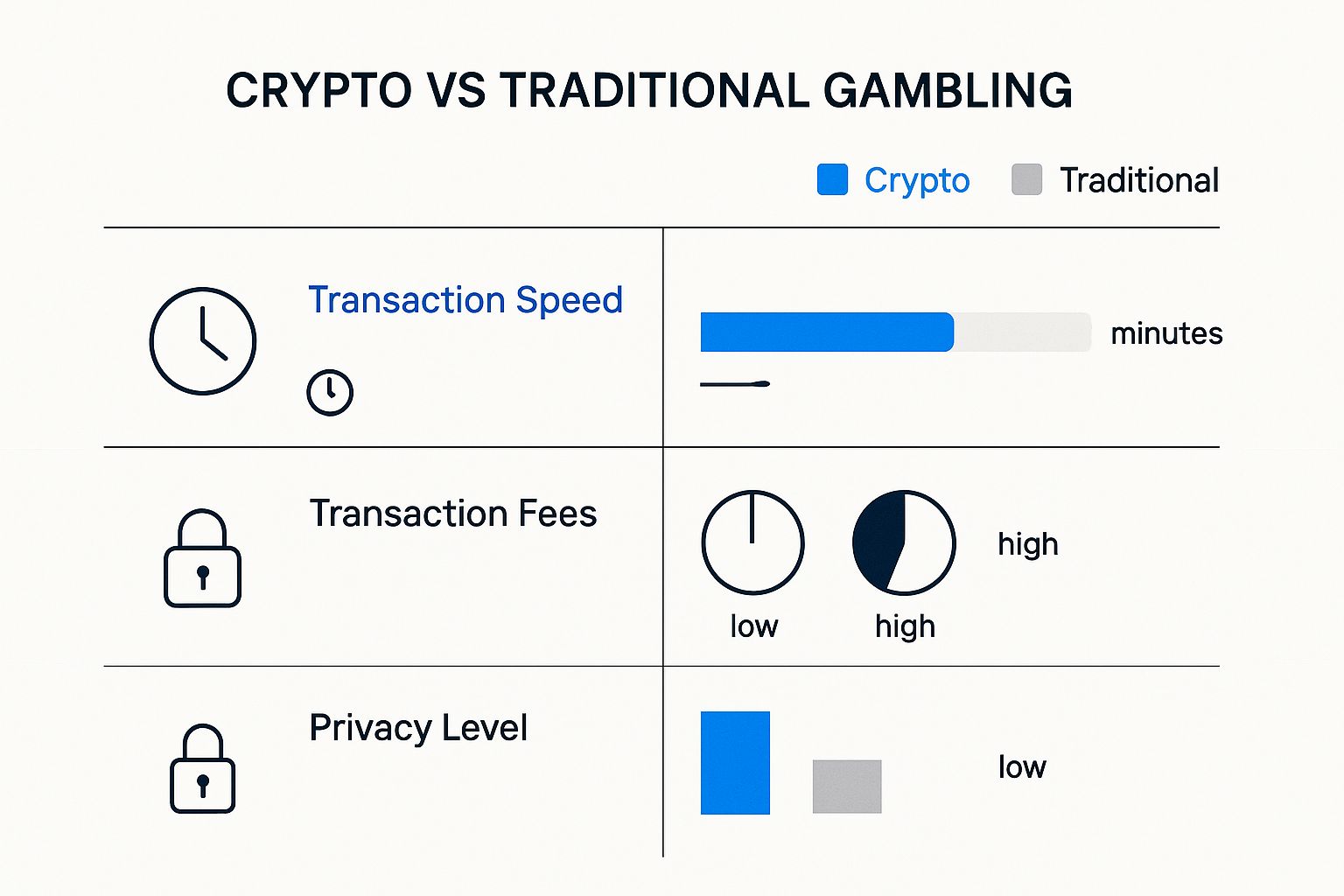 As you can see, the numbers speak for themselves. Crypto transactions are faster, cheaper, and give players more control over their information.
Enhanced Privacy and Anonymity
One of the biggest draws for players is enhanced financial privacy. Traditional online casinos almost always require you to hand over a lot of personal data, from bank account details to credit card numbers. All that information sits on a central server, making it a tempting target for hackers.
Crypto works differently. While transactions are logged on a public blockchain, they aren't tied directly to your name. Instead, they’re linked to your wallet address—a random-looking string of characters. This means you can move money in and out of a gambling site without exposing your personal banking information, keeping your financial activity discreet.
Unparalleled Transaction Speed
Waiting for your winnings is probably the most frustrating part of traditional online gambling. Bank transfers can drag on for days, getting stuck in processing queues or held up by banking hours.
This is where crypto really pulls ahead. Withdrawals are processed on the blockchain and usually land in your wallet within minutes. A Bitcoin transaction might take about 10-20 minutes to be confirmed, and other coins like Solana or Litecoin are often even quicker.
That near-instant access to your money is a complete game-changer. The payout process goes from a long, anxious wait to a fast, reliable transfer.
Significantly Lower Transaction Fees
Every time you move money through the traditional system, intermediaries like banks and payment processors take a slice. These fees add up, especially for international players who get hit with currency conversion and cross-border charges.
Because cryptocurrencies run on decentralized networks, they cut out most of these middlemen. You'll still pay a small network or "gas" fee to process the transaction, but it's typically a fraction of what traditional services charge.
Let’s look at a quick comparison to see how this plays out in the real world.
Crypto vs Traditional Gambling Transactions A Comparison
The differences between using crypto and standard fiat currency for online gambling are stark. The table below breaks down the key distinctions feature by feature, showing where each method stands out.
| Feature | Cryptocurrency Gambling | Traditional Online Gambling |
|---|---|---|
| Transaction Speed | Deposits are instant; withdrawals take minutes. | Can take 3-5 business days for withdrawals. |
| Fees | Minimal network fees, often a few dollars. | Higher fees from banks and processors, can be 3-5%. |
| Privacy | Pseudonymous; no personal bank details shared. | Requires sharing sensitive financial information. |
| Accessibility | Global and borderless, 24/7 access. | Restricted by region and banking hours. |
| Security | Secured by cryptographic protocols on the blockchain. | Relies on third-party security and is vulnerable to breaches. |
As you can see, crypto holds a clear advantage in speed, cost, and privacy. For players, this means keeping more of their winnings and having faster access to their funds without jumping through traditional banking hoops.
Many of these perks are a direct result of the underlying system that powers cryptocurrencies. To get a better sense of how this works under the hood, you can read more about the benefits of blockchain technology in sports betting. This efficiency is exactly why crypto is becoming such a popular choice in the online gambling space.
Navigating the Risks and Challenges
While the world of crypto gambling is full of exciting possibilities, it's not without its pitfalls. We have to be realistic here. The very things that make crypto so appealing—its speed, privacy, and decentralization—also create some unique and serious risks.
To keep yourself and your money safe, you need to go in with your eyes wide open. The main trouble spots boil down to three things: the insane price swings of crypto, major security holes, and a legal landscape that's a confusing mess. Ignoring these can turn a winning streak into a costly lesson.
The Rollercoaster of Price Volatility
Let's get straight to the biggest issue in cryptocurrency and gambling: volatility. The value of coins like Bitcoin can shoot up or crash down in the blink of an eye. In a way, your crypto balance is its own high-stakes game before you even place a bet.
Imagine you hit a huge jackpot, but by the time you cash out to dollars or euros, its value has tanked. That's a real possibility. On the flip side, the money you deposit could shrink in value before you've even had a chance to play. This wild unpredictability adds a whole other layer of financial risk on top of regular gambling. To get a handle on this, you'll need to apply some expert bankroll management tips to stay in control.
Inherent Security Risks: Hacks and Scams
Being your own bank is empowering, but it also means you’re solely responsible for security. And unfortunately, the crypto world is a playground for hackers and scammers who have gotten very good at stealing funds.
You have to be on the lookout for a few common threats:
- Phishing Scams: These are fake emails or websites trying to trick you into giving away your private keys or passwords. They can look incredibly convincing.
- Malware: Malicious software that can infect your computer or phone and quietly drain your crypto wallet.
- Unsecured Platforms: Let’s be honest, not all crypto gambling sites are built the same. Some have shoddy security, leaving them wide open to attacks that can put everyone's money at risk.
A non-negotiable rule in crypto: always enable two-factor authentication (2FA) on every single account you have. From your crypto exchange to the gambling site itself, this simple step is one of the strongest defenses against someone getting into your account.
The Complex and Unclear Regulatory Environment
The legal side of crypto gambling is a minefield. The rules can change dramatically depending on where you live—country to country, and even state to state. In some places, it's perfectly legal and regulated. In others, it’s a legal gray area or flat-out illegal.
For example, a country might have clear rules for traditional online casinos but nothing on the books yet for crypto. This leaves players completely in the dark. We've seen authorities, like those in Maine, issue public warnings about unlicensed iGaming sites, reminding players that they're on their own if something goes wrong.
This patchwork of laws means you often have zero legal protection if a shady platform runs off with your money. Before you even think about playing, it is absolutely essential to research the laws in your specific location. Knowing the rules of the road is the first step to protecting yourself.
The Explosive Growth of the Crypto Gambling Market
The world of online wagering is going through a massive shake-up, and the numbers behind the rise of cryptocurrency and gambling are simply mind-boggling. What started as a tiny niche has ballooned into a multi-billion dollar industry. This isn't a slow-and-steady trend; it's a full-blown explosion, powered by a new wave of players who want their betting to be fast, private, and on their own terms.
To get a real sense of this growth, just look at the data. The crypto gambling industry has shot up from a global revenue of just $50 million in 2019 to an estimated $250 million by 2024. That's a fivefold jump in only five years, which works out to a compound annual growth rate (CAGR) of nearly 38%. For a deeper dive into these numbers, you can check out the full analysis of the crypto gambling market.
This kind of rapid acceleration proves that crypto is no longer just a curiosity in the betting world—it's a major force that’s fundamentally changing how things are done. The sheer volume of wagers being handled on blockchain networks points to a huge shift in what players expect and how operators are responding.

Key Drivers Fueling the Expansion
So, what's behind this incredible momentum? A few powerful trends are pushing the crypto gambling sector forward. It’s not just about adding another payment option; it’s about offering a completely different—and for many, a much better—experience that solves some of the biggest headaches of traditional online gambling.
At the core of this growth are three main factors:
- Mainstream Crypto Adoption: As more people get comfortable with buying, holding, and using digital currencies, it’s only natural that they’d start spending them on entertainment like betting.
- Technological Innovation: The development of “provably fair” algorithms and games built on smart contracts has introduced a new level of trust. Players can now verify for themselves that the games are legitimate, something that was never possible before.
- Dissatisfaction with Traditional Systems: Let's face it, players are fed up. They're tired of slow payouts, high transaction fees, and having to hand over tons of personal data to old-school online casinos. Crypto offers a compelling way out.
When you put these factors together, you get the perfect conditions for explosive growth, attracting everyone from seasoned gamblers to a new generation of crypto-savvy players.
Who Is the Modern Crypto Gambler?
The profile of the average crypto gambler is changing, too. What was once a small community of early crypto adopters and tech nerds has expanded into a much wider audience. Today's crypto gambler is generally younger, comfortable with digital tech, and really values their privacy and independence.
They aren't just looking to place a bet; they are seeking an experience that aligns with the decentralized, user-centric ethos of web3. This includes instant access to funds and the ability to operate without traditional financial intermediaries.
This growing user base isn't just bigger; it's also more diverse. People are playing everything from classics like poker and blackjack to new, blockchain-native crash games and sports betting on decentralized platforms. The appeal is spreading because the benefits—efficiency, privacy, and control—are things that almost any online gambler can appreciate. It’s a trend that both players and operators need to be watching very closely.
Future Trends Shaping the Industry
If you think crypto gambling is big now, just wait. We're on the verge of another major leap forward, one that goes far beyond just using crypto to place a bet. The real future is about weaving the core ideas of web3—decentralization, ownership, and community—directly into the games themselves.
This next wave isn't just about faster payments. Imagine a world where your winnings are unique digital assets you truly own, not just numbers on a screen. Or picture yourself walking into a virtual casino that feels as real as anything on the Las Vegas Strip. These aren't far-off dreams; they're the concepts actively being built right now.
The Rise of DeFi and NFT Integration
Decentralized Finance, or DeFi, is about to completely change how we think about a player's bankroll. Instead of funds just sitting idle in a platform's wallet, you might soon be able to stake your crypto directly on the site. This could mean earning interest on your balance even when you aren't playing, an incentive model that traditional online casinos can't even begin to match.
At the same time, Non-Fungible Tokens (NFTs) are moving from collectibles to functional assets within these platforms. We're already seeing some really creative uses pop up:
- Unique In-Game Items: Imagine winning a rare, tradable NFT as a jackpot instead of a simple cash prize.
- VIP Access Tokens: Holding a specific NFT in your wallet could automatically grant you access to high-roller tournaments or exclusive tables.
- Platform Governance: Some platforms are even experimenting with NFTs that give players a voice in how the site is run.
This shift toward digital ownership gives players a real, tangible stake in the platforms they use. You're no longer just a customer; you're part of a community with verifiable assets.
The integration of DeFi and NFTs will blur the lines between gambling, investing, and collecting. It represents a fundamental shift where players can build real value and have a verifiable stake in the gaming ecosystem.
The Metaverse and Next-Gen Blockchains
Looking a bit further down the road, the metaverse is poised to deliver fully immersive virtual casinos. This isn't just a fancier website. We're talking about putting on a headset, walking into a digital casino, seeing other players' avatars, and sitting down at a virtual poker table. It’s a social, interactive experience that finally closes the gap between online convenience and real-world atmosphere.
None of this would be possible without the engine running in the background: next-generation blockchains. While Bitcoin and Ethereum paved the way, newer networks are built for the speed and low costs this future demands. By 2025, the share of crypto transactions in online gambling has reached nearly 30% globally, a huge jump from 20% just three years prior. Powerhouses like Ethereum, TRON, and Solana are becoming the go-to choices because they can handle thousands of bets per second with tiny fees. As you can discover in these crypto gambling stats on Blockonomi.com, this efficiency is absolutely essential for creating the fluid, instant experiences that players will soon expect as standard.
Got Questions? We've Got Answers
Diving into the world of crypto and gambling naturally brings up a few questions. Let's clear up some of the most common ones to make sure you're feeling confident.
Is Crypto Gambling Actually Safe and Legal?
When it comes to safety, it all boils down to the platform you use. The best crypto casinos are serious about security, using tools like two-factor authentication and offering games that are provably fair. The golden rule? Stick with reputable sites that have a strong, positive history.
The legal side is a bit trickier. The rules for crypto gambling can change dramatically from one country to another—and sometimes even from state to state. It's on you to do your homework and check the specific laws where you live before you start playing.
What Are the Go-To Cryptos for Gambling?
You've got a lot of choices, but a handful of coins dominate the scene for good reason.
- Bitcoin (BTC) and Ethereum (ETH): These are the big two. Just about every crypto casino accepts them because they're so widely known and easy to trade.
- Litecoin (LTC) and Dogecoin (DOGE): Looking for speed and lower fees? These are fantastic alternatives to Bitcoin, making them a popular choice for quick deposits and withdrawals.
- Tether (USDT): If you're not a fan of price swings, USDT is your best bet. It's a stablecoin, meaning its value is tied to the U.S. dollar, so you can gamble without worrying about market volatility.
What Does "Provably Fair" Mean, Anyway?
Provably fair is a game-changer that's only possible because of blockchain technology. It's a special kind of algorithm that lets you, the player, personally check and confirm that the outcome of every single bet was truly random.
Think of it this way: the casino uses cryptography to show you its cards, proving it didn't rig the game. This brings a whole new level of trust and transparency to online gaming that you just don't get with traditional sites.
Ready to accept crypto payments without the hassle? ATLOS offers a secure, no-KYC payment gateway that gives you total control. Get started with ATLOS today and simplify your operations.