Crypto Treasury Management A Modern Business Guide

At its heart, crypto treasury management is just like traditional treasury management, but for digital assets like Bitcoin and stablecoins. It’s all about strategically handling a company's crypto holdings to get the best returns, make sure cash is available when needed, and keep financial risks in check.
Why Businesses Are Rethinking Treasury Management

Corporate finance is at a major turning point. For years, treasury management was a fairly straightforward job: manage cash, handle investments, and mitigate financial risks, all within the world of traditional currencies. But that's changing. A growing wave of companies is now weaving digital assets into the very fabric of their financial strategies.
This isn't just some fleeting trend. It’s a direct response to a new economic reality. Businesses are on the hunt for better ways to boost efficiency, find new avenues for growth, and shield their balance sheets from market volatility. This is where crypto treasury management comes in, offering a whole new set of tools to tackle these modern challenges.
The New Financial Frontier
Think of this new approach as extending the classic principles of financial management into the blockchain world. It’s so much more than just buying some crypto and hoping for the best. It's a full-blown operational function that re-imagines how a company’s financial assets are held, moved, and leveraged.
To do this well, a business needs to get a handle on a few key things:
- Secure Asset Custody: This is non-negotiable. You need rock-solid systems to protect digital assets from hacks and theft, whether you're holding the keys yourself or using a trusted custodian.
- Strategic Asset Allocation: It's all about making smart choices. Deciding which assets to hold—from something like Bitcoin to price-pegged stablecoins—depends entirely on your company's risk tolerance and what you’re trying to achieve.
- Efficient Operations: Digital assets can make everyday finance run smoother. Things like cross-border payments, payroll, and paying suppliers can become faster and cheaper.
- Regulatory Navigation: The rules for crypto are constantly changing. Staying on top of compliance, accounting standards, and tax laws is absolutely crucial.
Beyond Speculation to Strategic Imperative
The conversation has officially moved on from "what if?" The rise of crypto treasury management signals a massive shift in corporate finance, with companies integrating digital assets into their strategies on a large scale. Just look at a company like MicroStrategy, which famously holds a massive Bitcoin position. They're a prime example of institutions treating crypto as a core treasury asset. And it's not just Bitcoin; other firms are diversifying into Ethereum and other digital assets.
This shift represents a move from passive observation to active participation. Companies are no longer just asking "what if?" about crypto; they are building the infrastructure to make it a central part of their financial engine.
This strategic pivot is all about tangible results. For CFOs and other financial leaders, understanding the strategic case for Bitcoin payments in retail is the first step toward driving real change. By getting comfortable with digital assets, companies can operate more effectively on a global scale, hedge against risks in traditional markets, and tap into new ways of creating value that simply didn't exist before. It's not about throwing out the old system, but about enhancing it with powerful new tools.
The Three Pillars of a Strong Crypto Treasury
Building a solid crypto treasury strategy is a lot like constructing a fortress to guard your company's digital wealth. It’s not about one single defense, but a combination of structures that all depend on each other. A truly robust approach rests on three core pillars, each one tackling a critical area: security, foresight, and governance.
Think of these pillars as the blueprint for creating a secure and compliant treasury function that can handle whatever comes its way, whether it's an external threat or an internal mistake.
This diagram shows how these three components fit together, forming the bedrock of any successful crypto treasury management program.
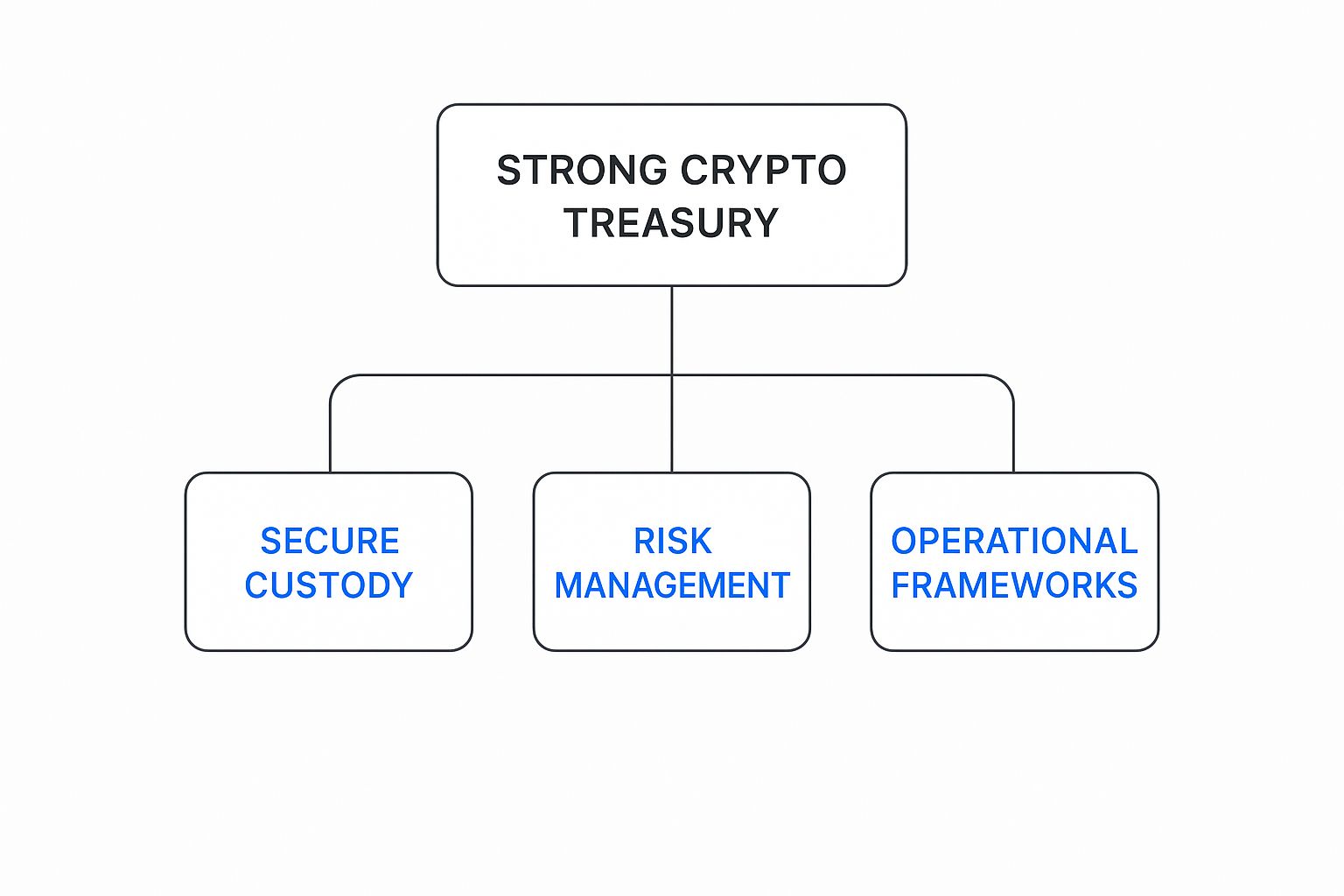
As you can see, secure custody, risk management, and operational frameworks aren't just separate boxes to check. They're interconnected supports for the entire structure. If one pillar weakens, the whole system is at risk.
Pillar 1: Secure Custody — Your Digital Vault
The first and most fundamental pillar is Secure Custody. This is your digital Fort Knox. How you choose to store and access your company's crypto assets directly determines your security and level of control. It's a foundational decision that forces you to weigh convenience against direct ownership.
There are a few models to think about, each with its own pros and cons.
- Self-Custody: This gives you absolute control over your private keys—and therefore your assets. While it offers the highest degree of sovereignty, it also means the entire security burden falls squarely on your team's shoulders.
- Third-Party Custodians: These are specialized companies, often insured and regulated, that hold your crypto for you. This approach offloads a lot of the technical security work, but it does require placing your trust in an external partner.
- Multi-Party Computation (MPC) Wallets: A more modern option, MPC technology splits private keys into multiple "shards" held by different people or devices. This design gets rid of single points of failure, since no one person can authorize a transaction alone. It offers a powerful mix of security and day-to-day flexibility.
Choosing the right custody model is a strategic move that hinges on your company’s technical skills, risk appetite, and operational needs.
To help you decide, here’s a look at how these custody models stack up against each other. Each one offers a different balance of control, security, and convenience, making the choice a critical first step in building your treasury.
Comparing Crypto Treasury Custody Models
| Custody Model | Key Features | Security Level | Best For |
|---|---|---|---|
| Self-Custody | Full control over private keys; no third-party reliance. | High (if managed correctly), but entirely dependent on internal security. | Technically proficient teams who prioritize absolute control and sovereignty. |
| Third-Party Custodian | Assets held by a regulated, insured entity; simplified security management. | Very High (with insurance), but introduces counterparty risk. | Businesses seeking to outsource security complexity and gain regulatory peace of mind. |
| MPC Wallets | Key sharding eliminates single points of failure; flexible policy controls. | High, combining protocol-level security with operational flexibility. | Organizations that need a balance of strong security and team-based operational workflows. |
Ultimately, the best custody solution aligns with your organization's specific risk tolerance and internal capabilities. There's no one-size-fits-all answer, so a thorough evaluation is key.
Pillar 2: Proactive Risk Management — Your Defense System
The second pillar is Proactive Risk Management. If custody is your vault, then risk management is your complete defense system—the watchtowers, alarms, and patrol guards. The crypto market is incredibly dynamic and brings a unique set of challenges that demand constant vigilance and a clear plan to handle them.
A solid risk management plan for crypto treasury management needs to cover a few key areas. First up is market volatility. Digital asset prices can swing wildly, so you need policies for hedging or using stablecoins to keep that exposure in check.
Then you have technical risks. Smart contract bugs and protocol flaws can lead to devastating losses. Doing your homework and only interacting with audited, well-respected platforms is a must. Lastly, there's counterparty risk—the danger that someone on the other side of a transaction, like an exchange or a lending partner, won't hold up their end of the deal.
A proactive approach means you don't just react to threats as they happen. Instead, you anticipate where things could go wrong and build in controls to neutralize those risks before they can cause any real damage.
This pillar is all about fostering a culture of security and awareness across the whole company, not just in the finance department.
Pillar 3: Operational Frameworks — Your Command Center
The third and final pillar is Operational Frameworks. This is your command center, where you define and enforce all the rules of engagement, internal policies, and compliance procedures. Without a strong operational framework, even the best custody and risk strategies can be completely undone by simple human error or bad actors inside the company.
This pillar makes sure your daily treasury activities are consistent, transparent, and can be audited. Key elements include:
- Internal Policies: Creating clear, written rules for everything from who can approve a transaction to how you onboard and offboard employees with wallet access. This involves setting up specific roles and permissions to ensure no single person has too much power.
- Regulatory Adherence: Staying on top of Anti-Money Laundering (AML) and Know Your Customer (KYC) regulations is not optional. You'll need transaction monitoring and reporting systems to comply with the law everywhere you do business.
- Auditability: Your operations have to be able to stand up to scrutiny. That means keeping flawless records of every transaction, decision, and policy update to ensure a clear audit trail for internal reviews or regulatory checks.
Together, these three pillars—Secure Custody, Proactive Risk Management, and Operational Frameworks—create a complete and resilient foundation for managing your company's digital assets with real confidence.
Actionable Strategies for Putting Your Digital Assets to Work

Once you've locked down your custody, risk management, and operational frameworks, it's time for the interesting part: putting your digital assets to work. True crypto treasury management isn't just about playing defense; it’s about going on offense and actively using those assets to hit specific financial targets. Companies are graduating from just holding crypto to deploying it with clear, actionable strategies that create real value.
We're seeing three distinct approaches emerge, each with its own flavor of risk and reward. The right fit for your business boils down to your financial goals, how much risk you can stomach, and your long-term vision.
The Digital Gold Strategy
First up is what many call the "Digital Gold" strategy. This is all about holding a volatile asset like Bitcoin on the corporate balance sheet for the long haul. The thinking here is to treat it as a hedge against inflation and the steady erosion of fiat currency value over time.
It's a modern twist on how companies have traditionally held physical gold. It’s not meant for day-to-day spending; it’s a store of value that you hope will appreciate significantly down the road. You can’t talk about this without mentioning MicroStrategy, which has gone all-in on accumulating Bitcoin as its primary treasury reserve asset.
- Risk Profile: High. The elephant in the room is market volatility. A major price dip could wreak havoc on your company's balance sheet and even your stock price.
- Reward Profile: High. If the bet pays off and the asset appreciates as you hope, the returns could blow traditional reserve assets out of the water.
- Best For: Companies with a long-term mindset, a high tolerance for risk, and a deep conviction in the future of their chosen asset.
The Operational Backbone Strategy
Next, we have the "Operational Backbone" strategy. This one is less about speculation and more about practicality, using stablecoins to supercharge day-to-day financial operations. Since stablecoins are pegged to something like the U.S. dollar, they sidestep the wild price swings of assets like Bitcoin, making them perfect for getting business done.
With this approach, a company's treasury might use stablecoins for everything from paying international suppliers to running global payroll or settling invoices. This simple switch can obliterate traditional banking delays and slash expensive wire fees, making your entire operation faster and leaner.
This strategy transforms the treasury from a simple cost center into a source of operational efficiency. It uses blockchain technology to solve immediate, practical business problems.
This is a powerful use of crypto treasury management that provides immediate, tangible benefits without the speculative risk of holding more volatile assets.
- Risk Profile: Low to Moderate. The risks here are different. You have to watch out for things like smart contract vulnerabilities in the stablecoin's code or a dreaded "de-pegging" event where the stablecoin loses its 1-to-1 value.
- Reward Profile: Moderate. The payoff isn't from your assets gaining value. Instead, it's measured in cost savings and a much smoother, more efficient operation.
- Best For: Global businesses with a lot of cross-border payments, companies trying to simplify their payment systems, and any organization looking to break free from slow, expensive old-school banking.
The Active Yield Strategy
Finally, there’s the "Active Yield" strategy. This is for companies that want to make their idle digital assets earn their keep. Instead of letting crypto just sit in a wallet collecting digital dust, you deploy it in Decentralized Finance (DeFi) protocols to generate fresh revenue streams.
This can look like a few different things:
- Staking: You lock up assets like ETH to help secure the network and, in return, you earn rewards.
- Lending: You supply your assets to lending protocols, where others can borrow them, and you earn interest on the loan.
- Liquidity Providing: You add your assets to a liquidity pool on a decentralized exchange, helping others trade, and you get a cut of the transaction fees.
This isn't a set-it-and-forget-it plan; it demands a solid technical understanding and active management. To really pull this off and get a clear picture of your holdings across different platforms, you'll need one of the best crypto portfolio trackers.
- Risk Profile: High. This path introduces a new set of dangers, from smart contract bugs and protocol hacks to the risk of a borrower defaulting in a lending platform.
- Reward Profile: High. The potential returns can be dramatically higher than what's available in traditional finance, creating a powerful new income source.
- Best For: Crypto-native companies or businesses with a dedicated, expert team that can do the heavy lifting of due diligence and actively manage the risks that come with DeFi.
How Tokenized Assets Are Bridging Two Worlds
The wall between traditional finance (TradFi) and the digital asset world is getting lower every day. For corporate treasurers, this shift is introducing powerful new tools that blend the stability of old-world assets with the speed and efficiency of new-world tech. This is where Real-World Assets (RWAs) are changing the game.
At its core, an RWA is a tangible asset from the physical world—think real estate, art, or government bonds—that has been converted into a digital token on a blockchain. This process, called tokenization, is fundamentally reshaping the possibilities for crypto treasury management.
The Rise of Tokenized Treasuries
Of all the RWAs making waves, tokenized U.S. treasuries might be the most impactful. Imagine taking the security and predictable yield of a government-backed bond and giving it the superpowers of a digital asset. That’s exactly what’s happening.
These aren't speculative cryptocurrencies. They are digital receipts for one of the world's most stable financial instruments. For a corporate treasury, this opens the door to earning stable, government-backed yield with the 24/7 liquidity, transparency, and global reach of the blockchain.
This trend marks a critical point where the reliability of established finance meets the agility of modern technology, giving treasurers the best of both worlds.
Why Companies Are Adopting On-Chain Treasuries
It's not just crypto-native firms jumping in; traditional companies are also turning to these on-chain instruments for a few clear reasons. The appeal is straightforward because it solves several core treasury challenges.
- Stable, Predictable Yield: In the wild west of crypto markets, tokenized treasuries offer a reliable, low-risk return. This lets companies put idle cash and stablecoins to work without exposing their principal to massive price swings.
- Enhanced Liquidity: Traditional bonds are stuck with banking hours. Tokenized treasuries, on the other hand, can be bought, sold, and moved around the clock. This constant liquidity is a huge advantage for businesses operating across different time zones.
- Superior Collateral Management: On-chain treasuries are considered high-quality collateral in the DeFi world. Companies can use them to secure loans or back other financial positions with a stable asset, which reduces risk and makes their capital work harder.
- Increased Transparency: Every single transaction is recorded on the blockchain, creating a perfect, unchangeable audit trail. This level of transparency makes life much easier for treasury departments when it comes to accounting and reporting.
By bringing traditional assets on-chain, companies are building a more resilient and versatile treasury. They can now access stable yields without ever leaving the blockchain ecosystem, creating a more integrated financial strategy.
The growth here has been explosive. Tokenized money market funds backed by U.S. Treasuries saw their assets under management (AUM) jump from about $2 billion to more than $7 billion in the U.S. in just one year. While still a tiny slice of the massive U.S. government debt market, this rapid expansion signals a real, growing demand for regulated, liquid, and yield-bearing on-chain assets. You can learn more about how crypto is affecting real-world assets.
A Practical Example in Action
Let’s look at a Web3 company holding a large chunk of its treasury in USDC stablecoins. In the past, that cash might just sit in a wallet, earning next to nothing.
By converting that USDC into a tokenized U.S. Treasury fund, the company can suddenly:
- Start earning a competitive yield that's backed by the U.S. government.
- Maintain liquidity with the ability to access its funds anytime, day or night.
- Use the tokenized treasuries as collateral in a DeFi lending protocol if it needs to borrow other assets.
This one strategic move turns a static, unproductive asset into a dynamic, income-generating one, all without taking on major risk. It’s a perfect illustration of how bridging the TradFi and crypto worlds opens up smarter new avenues for crypto treasury management.
Putting Your Treasury Strategy into Practice
All the theory in the world about custody, risk management, and asset allocation is great, but execution is where the rubber meets the road. A beautifully crafted crypto treasury management strategy is just a piece of paper until you put it to work. This is exactly where dedicated platforms come in—they’re the bridge between your ideas and what actually happens day-to-day.
Think about it. The alternative is a messy patchwork of spreadsheets, hardware wallets scattered in a safe, and a bunch of manual, error-prone steps. A purpose-built platform takes all that chaos and turns your strategy into a secure, efficient, and repeatable process. It becomes the central command center for all your company's digital asset operations.
From Theory to Tangible Controls
One of the first real-world hurdles in managing a corporate treasury is stopping internal fraud and simple, but costly, human mistakes. A solid platform tackles this problem directly with permission controls you can shape to your needs. You can create specific roles and rules, making sure a junior accountant can queue up a payment, but a senior manager must be the one to give it the final sign-off.
This isn't just about security—it’s about building a smart operational workflow. For example, a treasurer could set a simple policy: any transaction over $10,000 requires at least two managers to approve it. Just like that, you’ve designed away the risk of one person sending a large, unauthorized payment. A complex governance idea becomes a simple, automated action.
Then there's the headache of accounting and auditing. Trying to manually track your cost basis, gains, and losses across a dozen different wallets and exchanges is an absolute nightmare. The right tools fix this by automating the reporting, turning tax season and audits from a source of dread into a non-event.
This screenshot from ATLOS gives you a feel for how a clean dashboard can simplify a core treasury function like creating payments.
You can see how a user just selects the asset, enters the amount, and adds the recipient. It takes what could be a tricky on-chain transaction and makes it feel as easy as a few clicks.
A Practical Scenario in Action
Let’s walk through a common situation for a global business to see how this all clicks together. Imagine a treasurer is managing a portfolio of USDC stablecoins. They need to pay suppliers in Asia and also keep an eye on how their short-term treasury holdings are performing.
Without a single platform, the process is fragmented and full of risk:
- First, they have to log into multiple wallets just to see how much they have.
- Next, they manually build and sign each transaction, sweating over every character of the wallet address to avoid a catastrophic typo.
- Finally, they have to remember to log every single detail in a separate spreadsheet for the accounting team.
This old-school manual approach is painfully slow and leaves the door wide open for security gaps and mistakes.
A dedicated platform like ATLOS brings all of these jobs into one secure place. It delivers the control, clarity, and security that teams need to manage digital assets confidently, transforming a high-stakes manual process into a reliable system.
With an integrated system, the treasurer handles everything from one dashboard. They can see their entire stablecoin portfolio in a single view, schedule recurring payments to international suppliers with multi-sig approvals baked in, and pull detailed performance reports automatically.
This is the real game-changer: moving from manual chaos to automated control. It lets the treasury team stop losing sleep over basic operational security and start focusing on what really matters—high-level financial strategy. This is how modern businesses handle digital assets at scale, with both confidence and precision.
What's Next for Your Treasury?
We've walked through the ins and outs of crypto treasury management, and one thing is clear: this isn't some fringe experiment anymore. It's quickly becoming a core part of how forward-thinking companies operate. From locking down assets with solid custody to smartly navigating risk and putting capital to work, we're witnessing a major shift in corporate finance.
The real question has moved from if a business should adopt digital assets to how they can build a smart, resilient system to manage them effectively.
The essentials we've covered—secure custody, sharp risk management, and clear operational rules—aren't just abstract ideas. They are the concrete foundation for any successful treasury program. Once that foundation is solid, you can start building on top of it with powerful strategies like holding digital cash reserves, speeding up global payments with stablecoins, or even earning yield through DeFi protocols.
Charting Your Course
If there's one thing to take away from all this, it's that stepping into the world of digital assets demands a thoughtful, security-first approach. This isn't about jumping on the latest trend. It’s about making measured decisions that fit your company’s long-term vision and comfort level with risk.
The goal isn't just to build a treasury function that works for today. It's to create one that's nimble enough to seize the financial opportunities of tomorrow.
That means keeping your team educated, staying on top of regulatory changes, and picking partners who give you the security and control you absolutely need.
A future-proof treasury is never finished; it's always evolving. By taking a deliberate approach to crypto treasury management, you’re setting your company up to do more than just get by. You’re positioning it to lead the pack, turning what others see as challenges into real opportunities for growth. In the years ahead, that kind of foresight will be what separates the leaders from everyone else.
Your Top Crypto Treasury Questions Answered
Dipping your toes into corporate crypto treasury can feel like a big leap, especially when you're coming from the world of traditional finance. Let's break down some of the most common questions that pop up when businesses start thinking about a digital asset strategy.
What's the Absolute First Thing a Company Should Do to Adopt Crypto?
Before you even think about buying a single satoshi, your first move is to draft a formal, board-approved investment policy. Think of this as your constitution for all things crypto. It’s the foundational document that lays out why you're holding digital assets, your appetite for risk, and exactly which assets are on the table. Every decision you make later will point back to this policy.
With that policy locked in, your next big decision is custody. How are you going to hold these assets securely? Whether you go with self-custody, bring in a third-party custodian, or use a sophisticated MPC wallet, your choice here will define your security protocols and day-to-day operations. Finally, you’ll decide on your initial allocation—how much you're putting in without betting the farm.
A well-defined investment policy isn't just a nice-to-have; it's non-negotiable. It gives you the governance framework you need to make sure your treasury's moves align with the company's bigger goals and can stand up to a tough look from auditors and shareholders.
How On Earth Do Businesses Handle Crypto Accounting and Taxes?
Let's be blunt: your standard accounting software isn't built for this. The wild price swings of crypto and the very specific rules from regulators mean you need a specialized toolset to stay compliant. Trying to shoehorn crypto into old systems is a recipe for disaster.
The only real solution is to use dedicated crypto accounting software. These platforms are built from the ground up to:
- Track Cost Basis: They automatically log the purchase price of an asset, which is absolutely essential for calculating capital gains or losses correctly.
- Monitor Every Move: You get a detailed, audit-ready trail of every single transaction across all your wallets and exchanges.
- Create Compliant Reports: They generate financial statements that follow current accounting standards, which makes tax time and audits infinitely less painful.
Without these tools, you're stuck with manual tracking in spreadsheets, which is not only a nightmare but also opens you up to huge compliance risks from simple human error.
Are Stablecoins Actually a Safe Bet for a Corporate Treasury?
For many companies, stablecoins are the first step into the crypto world. They offer a way to get involved without the roller-coaster volatility of assets like Bitcoin. But here’s the crucial part: not all stablecoins are the same. Their safety comes down entirely to how they are built and what's backing them up.
You really need to know the difference between the main types:
- Fiat-Backed Stablecoins: These are the most straightforward. Each coin is backed 1-to-1 by real currency, like U.S. dollars, sitting in an audited bank account. They're widely seen as the safest and most transparent choice.
- Algorithmic Stablecoins: These use complex algorithms and smart contracts to hold their price peg, without any direct fiat collateral. This design carries a much higher risk of breaking its peg, especially when the market gets shaky.
Before you add any stablecoin to your crypto treasury management playbook, you have to do your homework. That means digging into audit reports, understanding what makes up their reserves, and judging how transparent the issuer is. Only after that level of due diligence can you confidently use them for things like payments, earning yield, or just as a stable place to hold value.
Ready to put your crypto treasury strategy into action, securely and without the operational headaches? ATLOS gives you the control you need to manage digital assets with confidence, from custom permissions to automated reporting. Get a handle on your crypto finances today. See how it works at https://atlos.io.